THE OUTBREAK STARTED WITH ONE STRANGE NEWS REPORT — THEN MY WIFE GOT BITTEN, THE RADIO REVEALED A HIDDEN ZOMBIE BOSS, AND OUR SURVIVAL RULES BECAME THE ONLY THING KEEPING US ALIVE
THE OUTBREAK STARTED WITH ONE STRANGE NEWS REPORT — THEN MY WIFE GOT BITTEN, THE RADIO REVEALED A HIDDEN ZOMBIE BOSS, AND OUR SURVIVAL RULES BECAME THE ONLY THING KEEPING US ALIVE
The first rule was never written on paper.
It was written in my wife’s blood on the sleeve of my shirt while she looked me in the eyes and whispered, “Don’t let me become one of them.”
Six hours earlier, the news anchor had still been smiling.
That was the part I could never forget later. Not the fires. Not the abandoned cars. Not the bodies moving in the streets after they should have stopped moving. It was the anchor’s smile, stiff and polished under studio lights, while the red banner beneath her said UNUSUAL ATTACKS REPORTED AT EASTSIDE CREMATORIUM.
My name is Daniel Mercer. Before the outbreak, I was thirty-eight years old, a high school maintenance supervisor in Columbus, Ohio. I fixed boilers, patched drywall, replaced broken locks, and knew which teachers kept emergency candy in their desk drawers. My wife, Laura, taught second grade at a public elementary school two districts over. She believed children could survive almost anything if one adult in the room stayed calm.
That belief saved us more than once.
It nearly killed her too.
The morning everything started, our house smelled like toast, coffee, and the lavender candle Laura always burned before work. Rain tapped lightly against the kitchen window. The local news played on the small television above the counter while Laura packed leftover pasta into a blue lunch container.
I remember thinking we were lucky.
Not rich. Not special. Just lucky in the ordinary way people are before the world proves ordinary is fragile.
Laura kissed my cheek and said, “You forgot the eggs.”
I looked down at the skillet. Smoke curled from the edges.
“Not forgot,” I said. “Reimagined.”
She laughed.
That laugh would become the sound I chased through every dark hallway after.
At 11:47 a.m., the school district sent everyone home early because of “regional safety concerns.” At noon, I reached our driveway and saw Laura already standing in the living room, remote in hand, face pale.
On television, helicopter footage showed police cars outside the Eastside Crematorium. Yellow tape snapped in the wind. A paramedic stumbled backward from a loading bay. Two officers aimed weapons at someone near a hearse.
The anchor’s voice shook.
“Authorities are asking residents to avoid the area after multiple reports of violent behavior involving individuals believed to be injured or deceased—”
The feed cut.
For three seconds, the screen went black.
Then emergency tones screamed from every phone in the house.
CIVIL EMERGENCY MESSAGE. SHELTER IN PLACE. AVOID CONTACT WITH BITTEN OR UNRESPONSIVE INDIVIDUALS. DO NOT APPROACH FAMILY MEMBERS DISPLAYING AGGRESSION, CONFUSION, OR LOSS OF SPEECH.
Laura lowered the remote.
“Daniel,” she said, “what does that mean?”
Before I could answer, Mrs. Harlan from across the street ran barefoot into the road screaming for help.
Her husband followed her out of the garage.
He had died of a stroke the previous winter.
We both knew that because Laura had taken lasagna to the funeral.
Yet there he was, gray-faced, jaw hanging wrong, walking into the rain with one shoulder twisted beneath his burial suit.
Mrs. Harlan turned.
He lunged.
I grabbed Laura before she could reach the door.
“No.”
“She needs help.”
“No.”
Mrs. Harlan screamed once.
Then the world we knew ended in the street outside our living room window.
We did not have time to understand. We only had time to move.
I pulled Laura away from the window and killed the lights. We went room to room gathering what we could carry: bottled water, canned food, batteries, flashlights, first-aid kits, two kitchen knives, my old hunting rifle from the garage safe, a hammer, duct tape, rope, gloves, a crank radio, and the little lockbox where Laura kept birth certificates, insurance papers, and her father’s wedding ring.
By three o’clock, police sirens had become background noise. By four, they were gone.
At 4:22, the local station returned with a live emergency broadcast. The anchor no longer smiled. Her makeup had run beneath one eye.
“We are receiving confirmation from state officials that the infection is transmitted through bites and contaminated bodily fluids. Individuals exposed may show symptoms within one to six hours. The governor has activated the National Guard. Residents are instructed to remain indoors, barricade entry points, and avoid unnecessary sound.”
She looked off-camera.
Someone shouted in the studio.
The anchor looked back with terror now fully visible.
“If you are bitten,” she said, “isolate immediately.”
Then the broadcast died.
Laura turned to me.
“We can’t stay here.”
She was right.
Our house had too much glass. Too many windows. Too many ways in. Two streets over was an abandoned brick rental home I had helped secure after a fire damaged the upper floor the year before. It had steel basement doors, narrow windows, and a detached garage with tools still inside.
We waited until dusk.
Then we ran.
Rain fell harder by then, turning the streets silver under the last weak daylight. Cars sat abandoned at angles. A city bus idled against a curb with its doors open and no driver inside. Somewhere, a smoke alarm beeped endlessly. Somewhere else, someone cried for their mother.
We did not look.
That became Rule One before we even named it.
Do not run toward every scream.
It felt cruel at first.
Later, it felt like math.
We reached the abandoned house through the back alley. I broke the side door with the hammer, then repaired it from the inside with two boards and a steel bracket. Laura cleared the basement while I dragged an old workbench across the entrance. We used fishing line and empty soup cans to make noise alarms near both doors. I screwed plywood over the basement windows. Laura sorted food into piles on a dusty ping-pong table.
By midnight, we had a shelter.
Not a home.
A shelter.
There is a difference you feel in your bones.
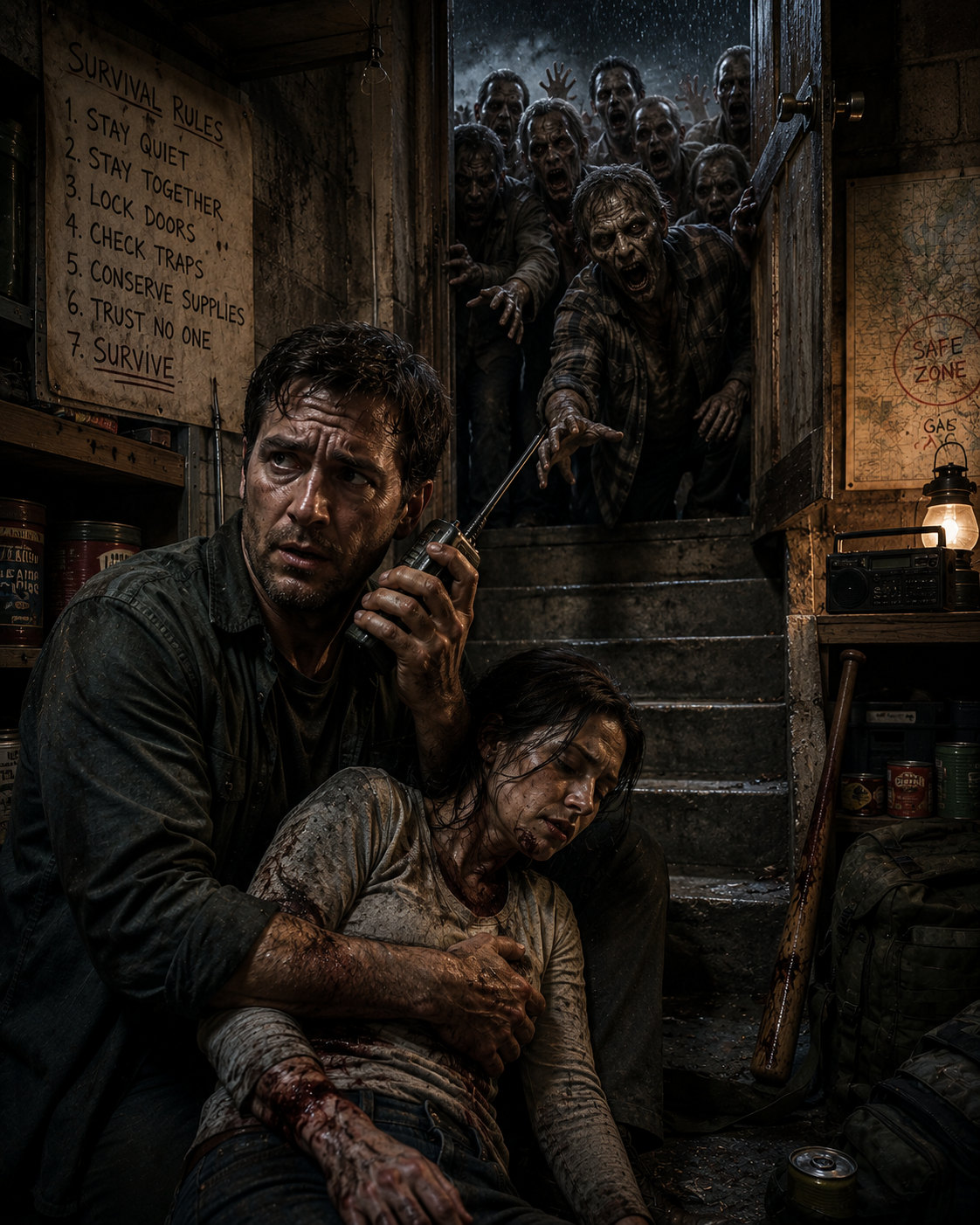
We wrote our survival rules on the inside of the basement door with black marker.
RULE 1: DO NOT CHASE SCREAMS.
RULE 2: SOUND KILLS.
RULE 3: FOOD AND WATER ARE COUNTED, NOT SHARED WITH PANIC.
RULE 4: TWO EXITS BEFORE SLEEP.
RULE 5: CHECK THE RADIO EVERY HOUR.
RULE 6: NO STRANGERS INSIDE WITHOUT PROOF.
RULE 7: IF BITTEN, ISOLATE.
RULE 8: STAY HUMAN OR NOTHING MATTERS.
Laura wrote the last one.
Her handwriting was steady.
Mine was not.
The first night, we slept on top of a kitchen table dragged into the basement corner because the radio said some infected crawled when their legs failed. Laura lay with her back against my chest. I could feel her heart beating too fast.
Above us, something walked through the house at 2:13 a.m.
Slow footsteps.
Kitchen.
Hallway.
Basement door.
The cans on the fishing line trembled but did not fall.
Laura stopped breathing.
A voice whispered through the door.
“Danny?”
It sounded like my younger brother, Caleb.
Caleb lived in Cincinnati.
I lifted the rifle.
The voice came again.
“Danny, open up.”
Laura’s hand found mine in the dark.
Rule Two.
Sound kills.
I did not answer.
The thing behind the door stood there for fourteen minutes.
Then it scratched once, gently, like a child asking permission, and walked away.
At dawn, I checked my phone.
No service.
But one voicemail had downloaded sometime during the night.
It was from Caleb.
Timestamp: 1:58 a.m.
His voice was frantic.
“Dan, if you get this, don’t answer anything that sounds like me. We heard them outside Mom’s apartment. They’re copying voices. I don’t know how. Just don’t—”
The voicemail ended in static.
That was the first clue that this was not only a virus.
By the second day, Columbus was broken.
I went out alone at 9:30 a.m. with the rifle, a crowbar, and a backpack. Laura hated the rule that I would scavenge while she guarded the shelter.
“You don’t get to decide your life matters more than mine,” she said.
“I’m not.”
“You are.”
I had no answer that would not sound like fear.
So she gave me a better rule.
“If you don’t come back in two hours, I leave. I do not wait until dark. I do not die because you wanted to be noble.”
I nodded.
“Say it,” she said.
“If I’m not back in two hours, you leave.”
She held my face in both hands.
“Good. Now come back before I have to hate you.”
The convenience store on Livingston Avenue had already been looted, but looters never think like maintenance workers. They take beer, cash, chips, cigarettes. They miss the utility closet.
I found bleach, gloves, duct tape, batteries, a first-aid refill kit, three protein bars behind a fallen display, and a portable AM/FM radio still in its package.
In the back office, I found security footage still recording from the night before.
I should have left it.
Instead, I watched.
At 1:11 a.m., a police officer staggered into the store with blood on his neck. At 1:14, two infected followed him. At 1:17, the officer shot one in the chest. It fell, then stood again. At 1:18, he shot it in the head. It stayed down.
Then the second infected stopped moving.
Not because it had been shot.
Because something outside the camera frame clicked twice.
The infected turned toward the sound like a trained dog.
Then it walked away.
I replayed that clip three times.
Click-click.
Command.
The radio broadcast that night confirmed what the footage suggested.
“This is Emergency Channel Nine out of Franklin County. If anyone can hear us, infected behavior is not random. Repeat, infected behavior is not random. Certain clusters appear to respond to audio patterns or centralized signals. Military sources are investigating reports of a controlling infected entity near the original Eastside site.”
Laura sat up slowly.
“Controlling?”
The radio hissed.
The voice continued, lower now, like the broadcaster knew he was saying something that would get him killed.
“Unofficial designation: Patient Crown. Avoid downtown. Avoid crematorium district. Avoid any infected that does not attack immediately. If it watches you first, run.”
Then another voice came through the transmission.
Calm.
Deep.
Almost human.
“Stay where you are.”
Laura and I stared at the radio.
The broadcaster whispered, “Oh God.”
Then screaming.
Then static.
Patient Crown.
That was the name that changed the outbreak from disaster to conspiracy.
Because someone had named it.
And if someone had named it, someone knew more than they were telling us.
On the third day, we found the first document.
It was inside a courier bag on the floor of an overturned county health department vehicle three blocks from our shelter. The driver’s door hung open. Blood streaked the steering wheel. The windshield had cracked outward, not inward.
Inside the bag was a sealed envelope marked FRANKLIN COUNTY PUBLIC HEALTH — BIOLOGICAL INCIDENT RESPONSE.
Laura read it while I watched the street.
Her face changed.
“What?”
She swallowed.
“This wasn’t first detected at the crematorium.”
“Where?”
She held up the page.
“Ridgeway Biomedical Storage.”
I knew the name. Everyone in Columbus did. Ridgeway was a private contractor that stored medical waste, research samples, and organ transport materials for hospitals across Ohio.
Laura kept reading.
“Subject samples transferred without federal notification. Unauthorized thaw event. Staff exposure. Local containment failure.”
I felt cold despite the heat.
“Date?”
“Six days ago.”
Six days.
The news had told us everything started yesterday.
The people in charge had known for nearly a week.
There were signatures at the bottom of the memo. County officials. A Ridgeway executive. A Homeland Security liaison. And one name circled in blue ink:
DR. ELIAS VANCE — NEUROVIROLOGY CONSULTANT.
On the back of the page, someone had written one sentence by hand.
VANCE SAID THE HIVE WOULD OBEY THE STRONGEST HOST.
Laura looked at me.
“The boss.”
We heard footsteps then.
Not shuffling.
Fast.
Organized.
Three infected turned the corner together and stopped at the end of the alley.
They did not moan.
They watched.
One clicked its teeth twice.
Click-click.
Behind them, more appeared.
Laura folded the memo and shoved it into her jacket.
“Daniel.”
“I see them.”
“Rule Four.”
Two exits before sleep.
Two exits before any fight.
We ran through the laundromat, out the rear door, over a fence, through a yard where a sprinkler still clicked over children’s toys. Behind us, the infected did not chase at first.
They waited.
Then a distant clicking sound echoed from somewhere downtown.
All at once, they ran.
That was when survival became discipline.
Every day after that, the rules kept us alive by inches.
We moved only during rain or wind because sound scattered. We never fired unless trapped. We slept above ground but never near windows. We marked safe routes with chalk under mailboxes. We kept food bags light enough to abandon. We trusted evidence more than hope.
But hope kept finding ways to hurt us.
On the fifth day, we heard a woman crying from inside a pharmacy.
Laura stopped.
Rule One stood between us.
Do not chase screams.
The crying became louder.
“Please,” the woman called. “My baby needs medicine.”
Laura’s face broke.
She was a teacher. Children were the soft place in her armor.
I gripped her wrist.
“No.”
“There’s a child.”
“We don’t know that.”
“We don’t know there isn’t.”
That was the cruelty of the new world. Every moral choice arrived disguised as a trap.
Then the crying stopped.
A man laughed softly inside the pharmacy.
“Got another one almost.”
Human.
Not infected.
We backed away without a sound.
Through the cracked glass, I saw three armed men crouched behind the counter with zip ties and knives.
Rule Six.
No strangers without proof.
The next morning, those same men tried to force their way into our shelter.
They came with flashlights and a white towel tied to a broom handle.
“Friendly!” one shouted from the alley. “We need help!”
I watched through a pinhole in the plywood.
The man in front wore a paramedic jacket with the name tag ripped off.
Laura stood behind me with the rifle.
“Proof,” I called.
“What?”
“Show bite checks. Wrists. Neck. Ankles.”
He smiled.
The smile told me everything.
“We don’t have time for games.”
“Then leave.”
His smile disappeared.
“We heard a woman in there.”
Laura raised the rifle and spoke before I could.
“And she heard you in the pharmacy.”
Silence.
Then the paramedic jacket man lifted his gun.
Laura fired through the plywood.
The shot was deafening in the basement.
Outside, a body hit the alley pavement. The other men ran. Within seconds, infected howls rose from two streets over.
Sound kills.
But sometimes silence kills faster.
We abandoned the shelter that afternoon.
We were carrying the radio, the Ridgeway memo, two backpacks, and the lockbox when Laura got bitten.
It happened because of me.
I have replayed it a thousand times and never found a version where that sentence becomes less true.
We were moving through the back of a closed grocery store, looking for canned goods left behind in the employee break room. I was checking the loading dock. Laura was ten feet behind me.
A freezer door opened.
Not fast.
Slow.
A hand reached through the gap and grabbed her sleeve.
She made one small sound.
Not a scream.
A shocked breath.
I turned and saw a stock clerk in a blood-stained apron pulling himself from the walk-in freezer. His lips were blue. His eyes had filmed white. He had been locked in there long enough to slow but not stop.
I drove the crowbar into his skull.
He fell.
Laura stood very still.
Her left forearm was bleeding.
The bite was deep.
For one second, the entire world narrowed to that wound.
Then she looked at me and said the words that became the first line of my memory forever.
“Don’t let me become one of them.”
I wrapped her arm. I dragged her out. I do not remember half the route back. Only fragments: rainwater in potholes, a burning ambulance, Laura stumbling, her blood warm against my palm, a church bell ringing though no one was pulling the rope.
We reached a storage unit facility near the railroad tracks. Unit B-17 was open and half empty. I barricaded the roll-up door with a vending machine and a stack of metal shelving.
Then I tied my wife to a support post with extension cords.
She watched me do it.
Neither of us pretended it was anything else.
“I’m sorry,” I said.
“No,” she whispered. “Rule Seven.”
If bitten, isolate.
Her skin grew hot. Her pupils shrank. Black lines spread beneath the skin near the bite like ink in water. I cleaned the wound with bleach solution, then alcohol, then antibiotic cream. She screamed into a towel while I held her down.
When it was done, she panted, “I hate your bedside manner.”
I laughed once, and it came out broken.
The radio crackled beside us.
Emergency Channel Nine returned in bursts.
“New medical advisory… bite survival possible in rare cases if wound is cleaned immediately, fever controlled, fluids maintained… do not terminate exposed individuals until cognitive loss is confirmed… repeat, do not terminate solely on exposure…”
Laura’s eyes filled with tears.
“Rare,” she said.
“Rare is not zero.”
“Daniel.”
“Rare is not zero.”
For two days, I kept her alive by rule and stubbornness.
Water every fifteen minutes. Fever cloths. Antibiotics from scavenged pharmacy bottles. Protein paste from canned beans. Wound checks. Pupil checks. Speech checks.
“Name?” I asked every hour.
“Laura Mercer.”
“Year?”
“Still the worst one.”
“Who am I?”
“Annoying.”
“Good.”
Sometimes she shook so hard the cords creaked. Sometimes she begged me to loosen them. Sometimes her voice changed in the dark and used words she would never use.
Once, at 3:40 a.m., she looked past me and smiled.
“He says he can make it stop.”
I froze.
“Who?”
“The man by the door.”
There was no man by the door.
“What does he look like?”
She tilted her head.
“Like the news doctor.”
I pulled the Ridgeway memo from my bag.
Dr. Elias Vance.
No photograph.
But I knew.
Patient Crown was not just controlling infected bodies.
It was reaching through infection.
On the third morning after the bite, Laura’s fever broke.
She woke with clear eyes, weak hands, and no hunger for flesh.
I untied her.
She collapsed into my arms.
For five minutes, neither of us spoke.
Outside, the city burned quietly under a gray sky.
Inside Unit B-17, my wife was alive.
That should have been the ending.
It was not.
Because Laura had brought something back from the edge.
“He’s downtown,” she said.
We sat on the concrete floor wrapped in emergency blankets.
“Who?”
“The one on the radio. Patient Crown. But that isn’t what he calls himself.”
My mouth went dry.
“What does he call himself?”
Laura looked toward the sealed storage door.
“Vance.”
The infected were not simply following a monster.
They were following a man who had become one.
She remembered pieces from the fever. A room with plastic curtains. White lights. A doctor speaking calmly while people behind glass argued. A phrase repeated over and over: obedience through neural convergence. Vance had been bitten during the Ridgeway containment failure. But instead of turning mindless, he had become the strongest host.
The hive obeyed him.
And the government knew.
That afternoon, we intercepted a military transmission.
“Operation Glass Crown authorized. Evacuation corridors active. Strategic strike pending. Civilian clearance window: twenty-nine days. Primary target remains mobile beneath downtown medical district. Conventional weapons ineffective against Crown-class host due to regenerative sheath.”
Laura leaned closer to the radio.
A second voice cut in.
“If Crown reaches the refugee corridor, evacuation fails.”
Then static.
We were not soldiers.
We were not chosen.
We were two exhausted people in a storage unit with a hunting rifle, a stolen medical bag, and a memo proving the outbreak had been hidden until it was too late.
But evidence matters, even at the end of the world.
Especially then.
We decided to get the Ridgeway memo to the evacuation zone.
Not because paper could stop the dead.
Because someone had let this happen, and if humanity survived, the truth needed to survive too.
The evacuation corridor was twelve miles west at the Ohio State Fairgrounds.
Between us and it stood half a city of infected, armed scavengers, military checkpoints, and whatever Vance had become beneath downtown.
We added new rules.
RULE 9: EVIDENCE TRAVELS IN TWO COPIES.
RULE 10: NEVER FOLLOW A VOICE YOU LOVE.
RULE 11: IF THE HORDE STOPS, HIDE.
RULE 12: IF LAURA HEARS VANCE, DANIEL DECIDES.
She hated Rule Twelve.
I hated needing it.
We made two copies of the memo at an office supply store running on emergency backup power. One copy went into the lockbox. The other Laura folded into a plastic sleeve and taped beneath her shirt.
At the copier, we found security footage on the store’s system from the first night. A convoy of black SUVs had passed the intersection at 2:17 a.m., escorted by police, heading away from Ridgeway. Thirty minutes later, infected flooded the same street.
The people with advance warning got out.
The rest of us got emergency alerts after lunch.
Laura watched the footage with a face I had never seen before.
Not fear.
Fury.
“They knew while I was teaching spelling words.”
I saved the footage to a thumb drive.
Evidence travels in two copies.
We moved west through neighborhoods that looked like abandoned movie sets. Birthday balloons still tied to mailboxes. Lawn sprinklers watering empty yards. A school bus stopped with backpacks scattered around it. On one porch, an American flag snapped upside down in the wind.
At Parsons Avenue, we found National Guard soldiers fighting to hold a checkpoint.
The infected came in waves, but not like a mob.
Like strategy.
They pushed from side streets, withdrew when machine guns swept left, then surged when soldiers reloaded. Some crawled under cars. Others climbed over the bodies of the fallen.
A captain named Mara Ellis pulled us behind a Humvee.
“You bitten?” she shouted.
Laura lifted her bandaged arm.
Captain Ellis raised her weapon.
“She survived,” I said.
“Nobody survives.”
Laura looked the captain dead in the eye.
“I did.”
Something in Laura’s voice stopped her.
I showed Ellis the Ridgeway memo.
Her expression hardened as she read.
“Where did you get this?”
“County vehicle.”
“Do you know what this is?”
“Proof.”
“No,” Ellis said. “It’s leverage.”
She took us to a temporary command post inside a bank lobby. Maps covered the walls. Radios hissed. Wounded civilians lay on yoga mats between teller windows.
A Department of Homeland Security official in a wrinkled white shirt tried to take the memo from me.
I pulled it back.
“Copies first. Witnesses present.”
His jaw tightened.
Captain Ellis smiled slightly.
“Smart man.”
We gave sworn video statements on a bodycam in the bank vault. Laura described the bite, the fever, the voice of Vance. I described the news report, the health department envelope, the security footage, and the copied voices.
When Laura said, “He can speak through the infected,” every radio in the room crackled at once.
A voice came through all channels.
“Laura.”
The room went still.
The voice was gentle.
“I can take the pain away.”
I stepped in front of her.
Captain Ellis raised one hand. Every soldier froze.
Laura’s face went pale.
The radio whispered again.
“Come downtown.”
I turned the volume knob off.
The radio kept speaking.
“Bring the evidence.”
Captain Ellis looked at me.
“You just became operationally relevant.”
Within an hour, we were inside the evacuation perimeter at the fairgrounds. Thousands of people filled livestock barns, exhibition halls, parking lots, and fenced lanes. Children slept on flattened cardboard. Volunteers handed out water. Doctors checked bite wounds behind plastic barriers. Names were written on duct tape across jackets.
The safe zone smelled like diesel, antiseptic, rain, and fear.
Laura was taken to a medical tent.
I followed until two soldiers blocked me.
“She’s my wife.”
A doctor in a face shield turned. “And she is the first confirmed bite survivor with cognitive stability. Let us work.”
Laura touched my hand.
“Go.”
“No.”
“Rule Eight,” she said.
Stay human or nothing matters.
So I let go.
For six hours, they tested her blood while I helped carry water crates and move fencing. I watched helicopters lift off toward the east. I watched buses roll west loaded with civilians. I watched families reunite and collapse. I watched soldiers cry in corners where they thought no one saw.
At sunset, Captain Ellis found me near the grandstand.
“Your wife’s blood slows the virus in lab samples.”
My knees almost failed.
“She’s a cure?”
“Not a cure. Not yet. But a door.”
There was that word again.
A door.
“Medical command needs time,” Ellis said. “Crown is moving west. If Vance reaches this perimeter before evacuation completes, he may take control of infected already contained in the bite wards.”
“What do you need?”
She looked toward downtown, where the skyline burned orange.
“We need to blind him.”
The plan was insane, which made sense because the world had become insane.
Vance was believed to be under the downtown medical district, inside an old research sublevel connected to Ridgeway’s emergency transport tunnels. He controlled the horde through sound, electrical interference, and infected neural response. Military strikes had failed because infected civilians clustered above him whenever drones approached. Heavy weapons risked collapsing the district with survivors still trapped in buildings.
But Laura’s blood changed the equation.
If doctors could synthesize enough of her antibodies, they could disrupt Vance’s signal in exposed infected. Not cure them. Not save the dead. But break his control long enough for evacuation to finish and a precision strike to hit the underground host.
They needed twelve hours.
Vance was three hours away.
So Captain Ellis formed a small convoy to draw the horde east and plant signal jammers around the medical district. I volunteered before she finished explaining.
Laura found out and slapped me.
Hard.
In front of two nurses and a colonel.
“You do not get to survive all this and then volunteer to die.”
“I’m not volunteering to die.”
“You always say that before doing something stupid.”
“Your blood gives them a chance. The jammers give them time.”
“And what do I get?”
I had no answer.
She stepped closer.
Her voice broke.
“What do I get if you don’t come back?”
I looked at her bandaged arm. Her tired eyes. The woman who had held children through fire drills and taught second graders to write thank-you notes. The woman who had survived a bite because she refused to surrender her own mind.
“You get the truth out,” I said. “You get to make them answer for Ridgeway.”
She cried then, silently.
Then she pulled me down by the collar and kissed me.
“Come back,” she said.
“That’s still the plan.”
“Daniel.”
“I’ll come back.”
The convoy left at 10:40 p.m.
Three Humvees, one armored ambulance, two utility trucks, sixteen soldiers, Captain Ellis, me, and a medic named Owen Price who had once been my neighbor’s quiet son before the apocalypse made everyone older.
Downtown Columbus looked like a city holding its breath.
Streetlights flickered over empty intersections. Smoke drifted between office towers. Infected stood in clusters facing east, motionless, as if listening to music we could not hear.
Then every head turned toward us at once.
“Contact,” Ellis said.
The first wave hit near Broad Street.
We did not mow them down like heroes. We survived by inches. Bursts of gunfire. Engine revs. Tight turns. Jammers placed on rooftops, traffic poles, and inside utility boxes. Every time one activated, nearby infected staggered and lost formation.
Vance felt it.
The radios screamed.
Not static.
Screamed.
Then his voice came through.
“Daniel Mercer.”
Captain Ellis looked at me.
I kept working.
“You left your wife.”
I bolted a jammer to a relay box with shaking hands.
“She is changing without you.”
I tightened the last screw.
“You know she will call your name with my voice.”
I slammed the casing shut.
“Signal active!” I shouted.
The infected below scattered, confused.
For the first time, the horde looked less like an army and more like a tragedy.
We reached the medical district at 1:12 a.m.
The final jammer had to be placed inside a substation behind Riverside Medical Center. The courtyard was full of infected standing shoulder to shoulder, silent and still.
At the center stood a man in a torn lab coat.
Not giant. Not monstrous in the simple way.
Human-shaped.
That made him worse.
His skin had hardened into a translucent gray sheath. Black veins pulsed beneath it. His eyes were clear. Intelligent. Terribly awake.
Dr. Elias Vance.
Patient Crown.
He looked directly at me.
“You brought her blood,” he said.
I raised my rifle.
He smiled.
The infected did not attack.
“They told you I am the monster,” Vance said. “Did they tell you they made me? Did they tell you Ridgeway thawed samples from military neurovirus trials? Did they tell you county officials signed the transport waivers? Did they tell you evacuation began for executives before public warning?”
I said nothing.
Because the worst part was, I believed him.
He lifted one hand.
“I am not the disease, Daniel. I am what survived it.”
Captain Ellis whispered through my earpiece. “Do not engage verbally.”
Vance’s head tilted.
“Laura understands. She heard the network. She knows humanity is noise. Hunger. Lies. Panic. I can make it quiet.”
I thought of Laura’s rule.
Stay human or nothing matters.
“Quiet isn’t peace,” I said.
“No,” Vance replied. “But it is obedience. And obedience survives.”
The infected surged.
The courtyard became chaos.
Captain Ellis’s team moved with brutal precision. Not glamorous. Not clean. Controlled fire. Retreat angles. Flashbangs. Jammers. Smoke. Owen and I crawled beneath an overturned ambulance toward the substation door while bullets cracked above us.
A soldier fell near the fountain. Two others pulled him back.
The infected adapted.
They avoided active jammer fields. They flanked. They used parked cars for cover.
Vance watched from the smoke.
Learning.
Owen reached the substation first. He opened the panel. I handed him the device. His fingers moved fast despite blood running down his temple.
Then Vance spoke in Laura’s voice.
“Daniel, help me.”
I froze.
Not because I believed it.
Because love does not need belief to wound you.
Owen looked at me.
“Rule Ten,” he said.
Never follow a voice you love.
I shoved the jammer into place.
Owen activated it.
A pulse ripped through the courtyard.
Every infected dropped.
Vance screamed.
Not in pain alone.
In rage.
The gray sheath across his body cracked. Beneath it, he was still a man. Sick. Ruined. Terrified.
For one brief second, I saw Dr. Elias Vance not as the boss, not as Patient Crown, but as the first victim who had decided that if he had been turned into a monster, the world owed him obedience.
Then the precision strike hit.
The ground lifted.
White light swallowed Riverside Medical Center, the courtyard, the tunnels, the substation, Vance, the infected, and every lie buried beneath that district.
I woke in the armored ambulance with Captain Ellis shouting my name.
Owen was alive.
Half the convoy was not.
The fairgrounds were still standing.
Laura was still alive.
The jammers had bought eleven hours and forty-three minutes. Close enough. Medical command synthesized an emergency serum from Laura’s antibodies. It did not save the fully turned. Nothing did. But it slowed fresh infections, protected medical staff, and broke cluster control in bite wards across three evacuation centers.
Three weeks later, the government destroyed the sealed downtown infection zone with thermobaric and chemical sterilization strikes. Not nuclear, despite the rumors. Targeted. Terrible. Necessary.
Three months later, the last controlled horde in Ohio collapsed after Vance’s signal degradation spread through the network.
One year later, the outbreak was declared contained.
Contained did not mean healed.
Cities were gone. Families were broken. Officials resigned, testified, lied, cried, blamed the dead, blamed the data, blamed panic. Ridgeway Biomedical’s executives were indicted. Franklin County officials faced federal charges for delaying public warning. Dr. Elias Vance became both monster and evidence.
Laura testified before Congress with the scar on her forearm visible.
She did not hide it.
When one senator asked if she blamed Vance, she looked down at the printed Ridgeway memos, then back up.
“I blame everyone who knew ordinary people were in danger and chose paperwork, reputation, and money over warning them.”
The room went silent.
Then she added, “But I also blame the monster who tried to make surrender sound like peace.”
That line played on every network for two days.
We live now in a rebuilt town outside Dayton, in a neighborhood where every house has storm shutters, radio antennas, water barrels, and a community board that lists supply counts beside birthdays. Laura teaches again. Smaller classes. More emergency drills. More hugs, though the district says she should be careful about that.
I work maintenance for the recovery authority. Locks. Generators. Water pumps. Doors.
Always doors.
Our basement wall still has the rules painted on it.
The old ones.
The new ones.
And one Laura added after the hearings.
RULE 13: THE TRUTH IS A SUPPLY. PROTECT IT.
Sometimes people ask how we survived.
They expect me to say guns. Food. Luck. Training. Love.
All of that mattered.
But the real answer is simpler.
We survived because when the world turned into noise, we made rules and followed them. We survived because Laura stayed human when something inside her told her not to. We survived because evidence outlived panic. We survived because a radio voice in the dark said there was a boss controlling the dead, and instead of giving up, we listened closely enough to find the man behind the monster.
On quiet nights, when the power hums steady and Laura falls asleep reading beside me, I sometimes hear clicking outside the window.
Click-click.
Usually it is just tree branches.
Usually.
I still get up.
I still check the locks.
I still check the radio.
And every time I come back to bed, Laura opens one eye and asks, “Anything?”
I always give her the same answer.
“Nothing we can’t survive.”
She reaches for my hand.
In the dark, her scar feels warm beneath my fingers.
Not infected.
Not cursed.
Alive.
And after everything we saw, everything we lost, everything that tried to turn us into animals, that warmth is still the strongest proof I know that the world did not win.
We did.