ALASKA BURIED THE 1998 OUTBREAK FOR DECADES — THEN I FOUND MY MOTHER’S AURORA FILES, A HIDDEN DENALI LAB, AND THE FINAL EVIDENCE THAT PROVED THE DEAD WERE NEVER SUPPOSED TO STAY DEAD
ALASKA BURIED THE 1998 OUTBREAK FOR DECADES — THEN I FOUND MY MOTHER’S AURORA FILES, A HIDDEN DENALI LAB, AND THE FINAL EVIDENCE THAT PROVED THE DEAD WERE NEVER SUPPOSED TO STAY DEAD
The thing in the freezer had my mother’s eyes.
Not her face. Not her voice. Not anything a son could mistake for comfort.
Just the eyes—blue-gray, furious, awake—staring at me from a body that had been dead long enough for Alaska to bury the story under twenty-six years of snow.
I found it behind Harper Lodge at 2:17 in the morning, locked inside an old meat freezer while the wind screamed down from Denali and the northern lights burned green over the black spruce. The metal door shook once every few seconds from the inside.
Bang.
Silence.
Bang.
Silence.
Like something was trying to remember how hands worked.
I should have run then. I should have gone back upstairs, packed my bag, and taken the first bush plane out of Talkeetna before daylight. But my mother had disappeared in Alaska in 1998, and three days before I flew north, a sealed envelope arrived at my apartment in Seattle with her name on the return label.
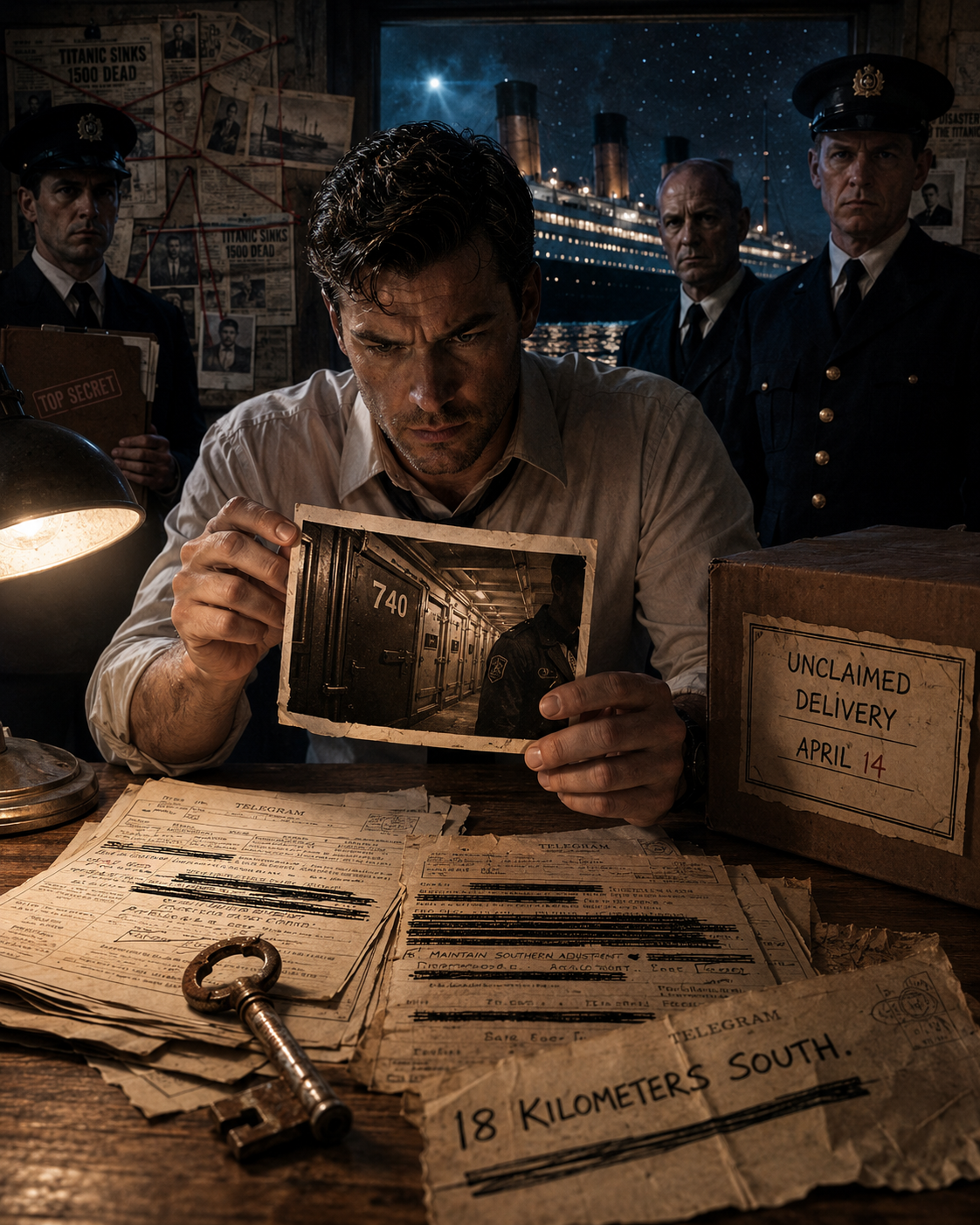
Inside were four things.
A Polaroid of my mother in a white lab coat.
A key stamped with the word AURORA.
A brittle map of the Denali foothills.
And one sentence written in handwriting I had not seen since I was eleven years old.
If they ever tell you I died, ask why the dead kept moving.
My name is Ethan Mercer. I am thirty-seven years old, a documentary researcher, the kind of man production companies call when they need courthouse records, old news footage, missing police reports, sealed depositions, and people willing to talk after midnight. I had spent fifteen years finding other families’ buried truths.
I never found my own.
My mother, Dr. Evelyn Mercer, vanished in March 1998 while working as a federal virologist in Alaska. The official story was clean enough to be insulting: small-plane accident, no wreckage recovered, presumed dead. My father accepted it because grief had hollowed him out. I did not. Even at eleven, I knew my mother did not vanish without leaving evidence.
She labeled leftovers.
She alphabetized field notes.
She kept receipts for parking meters.
A woman like that did not disappear into weather.
So when the envelope arrived, I went.
The plane into Talkeetna dropped through a ceiling of gray clouds that looked close enough to touch. The propellers vibrated so hard my teeth hurt. Out the window, Alaska stretched white and endless, a frozen continent of mountains, rivers, and dark forest. It did not look beautiful to me then. It looked like a place built to hide bodies.
A man named Luke Coleman picked me up from the small airport in a rusted blue Ford pickup with cracked leather seats and a rifle mounted behind the cab. He was twenty-eight, broad-shouldered, sun-browned in the way people are when snow and wind do more damage than summer ever could. He said he worked for Ella Harper, the woman who owned the lodge.
He did not ask about my flight.
He did not ask about my luggage.
He only said, “You shouldn’t have come.”
The heater coughed weakly as we drove north through spruce forest and snow-packed roads. Luke kept both hands on the wheel. His right wrist was wrapped in gauze.
I looked at the bandage.
“Work injury?”
His jaw tightened.
“Something like that.”
Thirty-eight miles later, Harper Lodge appeared through blowing snow. Three stories of dark timber, steep roof, yellow windows, and a porch that sagged under decades of ice. It had been built in the 1940s as a hunting lodge, sold twice, nearly abandoned, then reopened by Ella Harper after the oil crash. The building looked warm from the outside.
Inside, it smelled like woodsmoke, old coffee, wet wool, and something faintly rotten beneath the floorboards.
Ella Harper stood in the entry hall with a lantern in one hand.
She was sixty-eight, thin, silver-haired, and dressed in a navy wool sweater that made her face look even paler. Her eyes moved over me slowly, like she was comparing me to a memory.
“Ethan,” she said. “You look like her.”
I did not ask who.
We both knew.
“Why did you send the envelope?”
Ella’s fingers tightened around the lantern handle.
“Not here.”
Behind her, mounted on the wall above the fireplace, were black-and-white photographs of hunters, pilots, scientists, and smiling tourists from decades earlier. One photo had been turned facedown in its frame.
I noticed because the dust around it was clean.
Ella noticed me noticing.
“Dinner is at seven,” she said. “Room six. Rest first.”
“No.”
Her expression hardened.
“I came for my mother.”
“And if you want to leave with more than her name, you’ll learn when to stop talking.”
The words landed cold.
Upstairs, Room Six had a narrow bed, a writing desk, a cracked mirror, and a window facing the tree line. On the desk sat a guest book from 1998.
I opened it because I cannot stand closed books.
Most pages were ordinary: hunters from Fairbanks, honeymooners from Oregon, two German climbers, a family from Anchorage.
Then I found the week of March 16, 1998.
Three names had been cut from the page with a razor.
One signature remained beneath the cuts.
Dr. Evelyn Mercer.
My mother.
Beside her name, in a different pen, someone had written:
AURORA TEAM — DO NOT ASSIGN GROUND FLOOR.
My chest tightened.
I photographed the page.
At dinner, Ella served caribou stew in a long dining room paneled with dark pine. The only other guests were a couple from Anchorage, Robert and Maria Vale, who claimed they were there for a winter photography trip. Robert talked too much. Maria watched everything.
Luke sat across from me and barely touched his food. His left hand shook when he lifted his spoon. The gauze on his wrist had darkened.
“What happened to your arm?” I asked.
The room went quiet.
Ella lowered her spoon.
“Luke cut himself hauling wood.”
Luke looked at me.
“No, I didn’t.”
Ella’s face went flat.
“Enough.”
“He asked,” Luke said.
The fire cracked in the hearth. Outside, wind struck the windows so hard the glass shivered.
Luke pulled back the gauze.
The wound was not a cut.
It was a bite.
Human-shaped. Deep. Purple at the edges. Half-healed and half-wrong, like the flesh had tried to seal around something still moving inside.
Maria made a small sound.
Robert whispered, “Jesus.”
Luke covered it again.
“Two hunters went missing last week,” he said. “Jared Kimura and Tom Nash. They went out past the north ridge. Came back wrong.”
“Wrong how?” I asked.
Luke’s eyes flicked toward Ella.
She stood so fast her chair scraped the floor.
“Luke.”
He kept talking.
“They watched people. Didn’t speak unless spoken to. Didn’t sleep. Didn’t blink right. Tom bit me before they disappeared again.”
Robert pushed his bowl away.
Ella’s voice dropped.
“You’re scaring the guests.”
Luke laughed once, and there was no humor in it.
“They should be scared.”
He leaned toward me.
“If you hear something outside tonight, don’t open the door. Even if it sounds like someone you love.”
That was when the lodge went silent enough for me to hear the generator hum beneath the floor.
At 2:17 a.m., the freezer started banging.
I followed the sound down the back stairs, through the empty kitchen, and out into the storm. Snow cut sideways across my flashlight beam. The cold hit like a hand over my mouth. Behind the lodge, twenty yards from the kitchen door, stood an old metal freezer shed half-buried in drifts.
Bang.
I stepped closer.
Bang.
The padlock hung open.
Fresh blood dotted the snow.
I pulled the door.
The smell rolled out first: iron, rot, freezer burn, and old chemical antiseptic.
Inside, between hooks of butchered meat, something crouched in the corner.
It had once been a man.
Maybe.
Its skin was pale and stretched too tightly over bone. Frost clung to its eyelashes. Its mouth was dark with blood. Its clothes were shredded, but under the rags I saw the remains of a military cold-weather uniform.
Then it lifted its head.
Blue-gray eyes.
My mother’s eyes.
Not because it was her.
Because whatever had changed it had left something human trapped inside.
The thing opened its mouth.
The first sound was a wet scrape.
The second was my name.
“Ethan.”
I stumbled backward.
The freezer door slammed from the inside.
The lock clicked by itself.
I fell into the snow, breath tearing in my throat.
From an upstairs window, Ella Harper watched me.
She was holding the facedown photograph from the wall.
When I got back to my room, there was an envelope under my door.
Inside was the photograph.
My mother stood in front of a concrete building with five other scientists. Behind them, a triangular logo marked the wall: a white North Star inside a black triangle.
PROJECT AURORA
DENALI BIOLOGICAL RESEARCH ANNEX
MARCH 1998
Ella had written on the back:
Your mother did not die in the plane crash.
There was no plane crash.
At dawn, Luke found me in the dining room, drinking coffee that tasted like smoke and panic. He looked worse than the night before. Sweat shone on his forehead though the room was cold.
“You saw it,” he said.
“In the freezer.”
He nodded.
“Jared.”
I stared at him.
“That was one of the missing hunters?”
“What’s left of him.”
“Why is he locked behind the lodge?”
Luke looked toward the kitchen.
“Because Ella is feeding him.”
The cup stopped halfway to my mouth.
“Why?”
“Because she thinks there’s still someone inside.”
A floorboard creaked.
Ella stood in the doorway.
“There is,” she said.
Her voice sounded older in daylight.
She crossed the room and sat across from me. For the first time, she looked less like a suspicious innkeeper and more like a woman who had spent twenty-six years sleeping beside a secret that breathed.
“Your mother was my friend,” Ella said. “She saved my life in 1998. Then she made me promise to keep the lodge open.”
“Why?”
“Because Aurora wasn’t destroyed.”
Luke swore under his breath.
Ella ignored him.
“In 1998, the government called it an influenza outbreak. They locked down three villages, burned medical records, bought silence with relocation money, and buried the dead under public-health orders. But it wasn’t flu. It was a reanimation virus created under Project Aurora.”
Robert and Maria appeared in the doorway behind her, pale and silent. They had been listening.
Ella looked at all of us.
“The dead were never supposed to stay dead. That was the point.”
The words changed the temperature of the room.
Project Aurora had begun as a Cold War medical program, Ella said. Regenerative research. Cellular revival. Military trauma treatment. The official goal was to reverse tissue death after hypothermia, injury, or cardiac arrest. Alaska was the perfect test environment: isolated, cold, underpopulated, easy to close off with weather and authority.
My mother joined in 1994 as a federal virologist.
By 1997, Aurora could restart cellular activity after death.
By 1998, it could not stop what came back.
“The virus repaired tissue,” Ella said. “But not identity. It woke the body and left the person behind. Most turned violent. Some retained fragments. Names. Habits. Voices. Enough to make killing them feel like murder.”
Luke looked at his wrist.
“And bites?”
“Transmit the strain.”
I turned to him.
“How long?”
He swallowed.
“Jared bit me three days ago.”
Ella closed her eyes.
Robert stood abruptly.
“We need to leave.”
Maria grabbed his arm. “Robert.”
“No. Whatever this is, I’m not dying in some conspiracy lodge.”
He reached for his coat.
Ella said, “The road is blocked.”
“You don’t know that.”
“I know exactly who blocked it.”
Outside, engines approached.
Not one.
Several.
Heavy tires crunched over frozen gravel. Through the front windows, we watched white trucks pull into the lodge yard. Men and women in Arctic biohazard gear stepped out with rifles. Their shoulder patches showed the same black triangle and white star.
A woman in a white parka walked at the center of them.
Blonde hair tucked beneath a hood. Pale face. Cold eyes.
Ella whispered, “Astrid Novak.”
The front door opened without a knock.
Dr. Astrid Novak entered like she still owned the building.
“Good morning,” she said. “Everyone remain calm.”
No one did.
She introduced herself as director of the Arctic Biological Institute. That was the public name. The patch on her sleeve told the truth.
Aurora.
Her gaze found me immediately.
“Ethan Mercer.”
I stood.
“You knew my mother.”
“I did.”
“What happened to her?”
Novak’s expression did not change.
“She made the same mistake all brilliant people make. She believed conscience could survive inside a classified program.”
The armed team spread through the room.
Luke shifted beside me.
Novak saw the bandage.
“Mr. Coleman is infected. He needs to come with us.”
Luke backed away.
“No.”
“It is not a request.”
I stepped between them.
“You’re not taking anyone until you tell us what’s happening.”
Novak studied me like a blood sample.
Then she smiled faintly.
“Your mother really did build courage into you.”
That sentence hit too close.
Two soldiers grabbed Luke.
He fought. Maria screamed. Robert shoved one of the soldiers and got struck across the face with a rifle stock. Ella shouted at Novak to stop. I lunged and was slammed against the table.
The last thing I saw before they zip-tied my wrists was Ella slipping something into my coat pocket.
A key card.
And a folded note.
B7.
They turned the lodge into a quarantine site.
Plastic sheeting went up in the dining room. Portable lights flooded the walls white. Blood samples were drawn. Phones were confiscated. Robert and Maria were separated. Luke was taken upstairs. I was locked in Room Six with a guard outside the door.
But old lodges have old locks.
My father had been a locksmith before cancer took his hands and then his life. When I was a kid, he taught me the secret language of weak metal: pressure, patience, the tiny give before surrender.
I picked the lock with a belt clip and the edge of the Aurora key.
In the hallway, the guard was gone.
Somewhere below, men shouted. Something had broken containment.
I found Luke in Room Twelve.
He sat on the floor against the bed, breathing hard, skin damp, eyes bloodshot.
“They said seventy-two hours,” he whispered.
“For what?”
“To turn.”
His mouth twisted.
“I can feel it, Ethan. Like a second heartbeat. Like something inside me trying to learn my memories.”
I helped him stand.
“We’re leaving.”
“Where?”
“Denali.”
He stared.
“The lab?”
“My mother’s files are there.”
“And if the lab is why all this started?”
“Then it’s also where it ends.”
We made it to the service stairs before we ran into Hank Miller.
He was in his late sixties, military posture, gray beard, scar down one cheek. He wore no biohazard gear. Just a canvas coat, wool gloves, and a sidearm.
“I wondered when you’d break out,” he said.
Luke raised his rifle.
Miller did not flinch.
“Easy. If I wanted you dead, Novak would already have your blood in a centrifuge.”
“Who are you?” I asked.
“Former Army. Former Aurora security. Current man trying to die with one decent thing on his record.”
He led us through a storage room behind the kitchen and down into a Cold War-era tunnel beneath the lodge. The concrete passage smelled of earth, rust, and old water. Emergency lights glowed weakly every thirty feet.
“In 1998,” Miller said, “I helped seal the first outbreak.”
“You mean cover it up.”
His face tightened.
“Yes.”
Luke’s breathing grew harsher.
Miller looked at him.
“You’ll need serum soon.”
“There’s serum?”
“Your mother made one,” he told me. “Not a cure. A leash. Slows the change if the subject still has enough cognition to fight.”
“Where?”
“Denali Annex. Archive B7.”
I pulled out Ella’s note.
Miller nodded once.
“Ella always did have better timing than judgment.”
The tunnel ran half a mile before splitting north. Behind us, alarms began to echo from the lodge. Miller stopped at a steel door.
“This leads to the old service route. Snowmobile shed is outside. Follow the markers to the ridge. Denali Annex is buried under the weather station.”
“You’re not coming?”
He checked his pistol.
“Someone has to slow Novak.”
“Why help now?”
For the first time, shame crossed his face plainly.
“Because in 1998, I watched them drag children out of a village and call it containment. I have heard those children in my sleep for twenty-six years.”
He opened the door.
“Find the files. Find your mother’s final evidence. Put it somewhere no government office can bury it again.”
Then he shut us out into the snow.
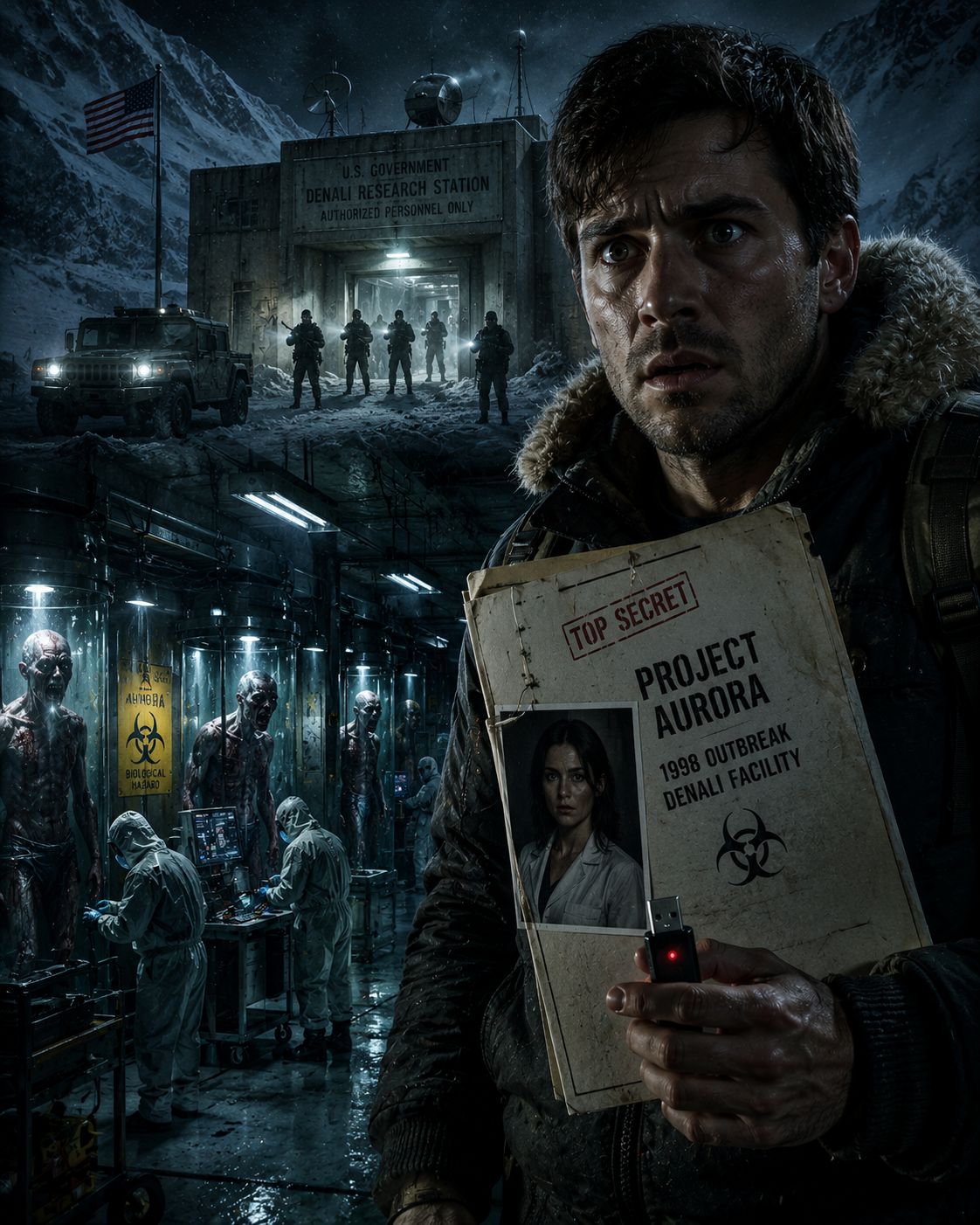
We reached the Denali weather station near dusk.
The sky had cleared. The northern lights moved over the mountains in green curtains, beautiful in a way that felt indecent considering what lay beneath us. The station itself was a squat concrete structure half-buried in snow, weather antenna bent under ice.
Luke entered the access code from memory.
“My father helped build this place,” he said. “He thought it was climate research until he saw the cages.”
The door opened.
Warm air breathed out.
Not abandoned air.
Maintained air.
Inside, the walls were white, the floors polished, the lights still alive. The triangle-and-star logo appeared on every door.
PROJECT AURORA
DENALI BIOLOGICAL RESEARCH ANNEX
We passed signs for Cryogenic Storage, Viral Engineering, Behavioral Containment, and Military Applications.
That last one made Luke laugh bitterly.
“There it is.”
“What?”
“The part they always lie about until the budget needs approving.”
The deeper we went, the more the building felt less like a lab and more like a confession. Observation rooms lined the halls. Behind thick glass floated bodies in greenish suspension fluid. Some wore hospital gowns. Some wore military uniforms. Some were not whole enough to identify.
One opened its eyes as we passed.
Luke stumbled.
I caught him.
His skin was burning.
“We need B7,” I said.
We found it behind two security doors and an old biometric scanner. The key from my mother’s envelope opened the first. My palm opened the second.
The scanner read:
MERCER, ETHAN
GENETIC AUTHORIZATION ACCEPTED
I stared at the screen.
Luke whispered, “What did your mother do to you?”
The archive lights came on one row at a time.
File cabinets. Tape drives. Hard-copy logs. Photographs. Lab notebooks. VHS tapes. A wall map connecting villages, military sites, burial locations, outbreak clusters, and bloodlines.
At the center hung a photograph of the founding Aurora team.
My mother stood beside Astrid Novak, Ella Harper, and a group of men in military uniforms. She looked young. Brilliant. Certain.
The caption read:
AURORA TEAM — 1994
CELLULAR REVIVAL INITIATIVE
Below it was another photo.
Same lab. Fewer people. My mother looked hollow-eyed, frightened, older by decades.
In her hands, she held a child.
Me.
I dropped into a chair.
Luke searched the shelves and found a medical case marked E.M. LINE — PROTOTYPE ANTIBODY SERUM.
Inside were six glass injectors.
One had my name printed on the label.
ETHAN MERCER — PRIMARY RESERVOIR.
The room tilted.
I was not just her son.
I was her backup plan.
A monitor flickered on.
My mother appeared on the screen.
Not young. Not from the photo.
Older. Exhausted. Filmed in this room in March 1998.
“If anyone finds this,” she said, “my name is Dr. Evelyn Mercer. Project Aurora has failed. The Department of Defense will classify this as a containment breach and bury the civilian deaths. They will say influenza. They will say exposure. They will say animal attacks. They will say anything except what we did.”
Her voice shook.
“The dead are not returning by miracle. We forced cellular reactivation through the Zeta-One viral vector. The body resumes function. Hunger becomes motor command. Pain inhibition allows extreme aggression. Memory fragments remain in some subjects, especially early-stage hosts, which means termination protocols may involve conscious suffering.”
Luke sank slowly against the wall.
The bite under his bandage pulsed dark.
My mother continued.
“I developed an antibody treatment using modified embryonic material from my son, Ethan. He is immune. I did this without consent. I did it because I believed I was protecting him from what I feared we had created. If he sees this one day, I need him to know I loved him before I used him as science.”
Tears blurred my vision.
On-screen, she looked directly into the camera.
“Ethan, I am sorry.”
The door behind us boomed.
Something hit it from outside.
Luke grabbed a serum injector.
“Do it,” he said.
I injected him in the thigh.
He screamed and collapsed, back arching, veins dark beneath his skin. For ten seconds, I thought I had killed him. Then his breathing steadied.
His eyes opened.
Still human.
“Rarely,” he whispered, “have I enjoyed medicine.”
I laughed once through tears.
The door boomed again.
A warning light flashed.
Novak had found us.
I downloaded everything: videos, logs, maps, serum formulas, outbreak reports, burial orders, command memos, bodycam footage from 1998, autopsy photos, sealed transportation manifests, a file labeled OPERATION WHITE MOURNING, and one folder titled FINAL EVIDENCE.
I opened it.
Inside was the thing no court, no government, no agency could explain away.
A live feed.
Containment Chamber A.
My mother sat behind reinforced glass.
Alive.
Older than she should have been.
Pale. Thin. Hair white. Eyes still hers.
My hand froze over the keyboard.
“No,” I whispered.
She lifted her head, as if she heard me through the camera.
A speaker crackled.
“Ethan?”
I could not breathe.
Luke stared at the monitor.
“Your mother’s alive.”
The archive door unlocked.
Novak entered with six armed soldiers.
Her face was calm, but her eyes went straight to the monitor.
“You weren’t supposed to find that.”
I stood slowly.
“You kept her alive.”
Novak’s expression flickered.
“She kept herself alive. Your mother injected herself after exposure. The serum prevented full conversion but halted aging inconsistently. She became proof of concept.”
“My mother became your prisoner.”
“She became the only reason this facility still has a chance to produce a cure.”
“She was here for twenty-six years.”
Novak said nothing.
That silence was confession enough.
Behind her, soldiers raised their weapons.
Luke’s voice dropped.
“Ethan.”
The serum had slowed him, not saved him entirely. His eyes shone too bright.
Novak noticed.
“Mr. Coleman is entering hybrid response. Fascinating.”
I hated her then with a clarity so clean it felt almost peaceful.
“You don’t get to study him.”
I hit ENTER.
The upload began.
Not to one address.
To every address in the dead-man network my mother had prepared: journalists, state records offices, tribal councils, federal courts, public-health watchdogs, foreign servers, university archives, retired prosecutors, and a folder labeled ETHAN IF THEY COME FOR YOU.
Novak saw the progress bar.
Her face finally changed.
“Stop that.”
“No.”
“You don’t understand what you’re releasing.”
“I’m releasing the truth.”
“The truth will panic the country.”
“The lie already killed people.”
She stepped toward me.
Luke moved faster.
He slammed into the nearest soldier, knocking the rifle upward. Gunfire cracked through the room. Glass shattered. Archive lights burst. I grabbed the drive and ducked behind a cabinet as Luke fought with a strength that was no longer entirely human but still completely his choice.
A soldier fired into a coolant line.
Vapor flooded the room.
The monitor showing my mother flickered.
She pressed one hand to the glass in Chamber A.
“Ethan,” she said through the speaker. “Listen to me.”
I crawled to the console.
“Mom.”
“There is a purge system.”
“No.”
“You have to use it.”
“No. I just found you.”
Her eyes filled.
“You found the truth. That is more important than finding me.”
“No, it isn’t.”
“Yes,” she said, and her voice became the voice from my childhood, the one that ended arguments because it loved me too much to let me lie to myself. “It is.”
Novak shouted orders through the vapor.
Luke roared.
The upload hit 92 percent.
My mother’s voice softened.
“I have been dead in every way that matters except one. I waited to tell you I did not leave you.”
My hand shook over the purge command.
“You were my whole life,” she said. “That was real. Whatever else I did, whatever they made of my work, that was real.”
The progress bar hit 100 percent.
Upload complete.
Then the facility alarm changed tone.
Novak had triggered security lockdown.
My mother looked past the camera.
“She’s going to move the specimens.”
“What do I do?”
“Open Chamber A.”
I stared.
“You said purge.”
“Open it first.”
I did.
Deep in the facility, a door unlocked.
On the monitor, my mother stood slowly.
She was weak, but she moved with purpose.
Novak saw the feed.
“No,” she whispered.
For the first time, Astrid Novak looked afraid.
My mother walked out of containment.
Every infected in the facility began screaming.
Not attacking.
Screaming.
As if something older than hunger had entered the halls.
“She’s the original host,” Novak said.
My mother’s voice came through every speaker.
“Aurora personnel, this is Dr. Evelyn Mercer. Final containment authority is mine.”
The system accepted her.
Doors sealed.
Red lights spun.
My mother looked into the nearest camera.
“Run, Ethan.”
Luke grabbed me with one hand.
His fingers were too hot.
“Listen to her.”
We ran.
Behind us, the archive erupted into chaos. Novak tried to reach the main console. My mother overrode her. Specimen chambers opened in controlled sequence, not to release the dead, but to draw them inward toward the purge tunnels.
She was using herself as bait.
The dead remembered her.
Creator.
Mother.
Mistake.
We sprinted through white corridors as alarms counted down.
PURGE IGNITION IN FIVE MINUTES.
Luke stumbled twice but kept moving. At the stairwell, he shoved the last two serum injectors into my coat.
“For others,” he said.
“For you.”
He shook his head.
“Not enough.”
“Luke—”
“I know what I feel.”
His eyes glowed red at the edges, but his voice was steady.
“I’m still me. Let me spend that while it counts.”
At the final junction, the armored bioweapon from the lab corridor burst through a side door. Massive, distorted, wearing torn tactical armor. It blocked the exit.
Luke turned to me.
“Tell them Jared wasn’t an animal. Tell them Tom wasn’t a monster. Tell them we were people.”
“You can tell them yourself.”
He smiled sadly.
“Not from where I’m going.”
Then he charged.
He hit the creature low, driving it into the wall. I ran past as metal screamed behind me. At the emergency hatch, I looked back once.
Luke had his teeth sunk into the thing’s throat, holding it there while the purge countdown echoed.
Three minutes.
Two.
One.
I climbed into daylight.
Snow blinded me.
I ran until my lungs tore.
The mountain behind me made one deep sound, not an explosion but a collapse, as if the earth had decided to close its mouth around Project Aurora forever.
A plume of steam and gray snow rose into the sky.
The northern lights shimmered above it.
Then everything went quiet.
I thought the truth would save me immediately.
It did not.
Truth rarely arrives like rescue. It arrives like a wound people first try to cover.
For thirty-six hours, I hid in an abandoned ranger station while helicopters searched the ridges. I used an emergency satellite uplink from the station to confirm the files had landed. Dana Wells at Pacific Public Record had them. The Anchorage Daily News had them. A tribal health council in Fairbanks had them. A federal judge in Oregon had them. Three international medical ethics boards had them.
By the time Novak’s people found the ranger station, the story had already broken.
ALASKA OUTBREAK COVER-UP LINKED TO SECRET FEDERAL LAB.
PROJECT AURORA FILES REVEAL REANIMATION VIRUS TESTING.
MISSING VIROLOGIST HELD IN DENALI FACILITY FOR DECADES.
They did not shoot me.
Too many cameras were watching now.
The hearings began six months later in Anchorage.
I testified under oath with my mother’s video files playing on a screen behind me. Ella Harper testified next. She admitted she had taken money to keep the lodge open as an observation post, then broke down describing the people she had hidden, fed, and failed.
Hank Miller survived long enough to testify by deposition. He named commanders, dates, villages, burial pits, and the exact language used in orders that turned civilians into “containment variables.”
Astrid Novak sat at the defense table in a gray suit, thinner now, no white parka, no soldiers behind her. She looked human in court.
That made her crimes feel worse.
When prosecutors played the final video of my mother walking into the purge corridor, the courtroom became so quiet I could hear someone crying three rows back.
My mother looked into the camera one last time.
“If science asks you to remove the soul from the equation,” she said, “burn the equation.”
Then the screen went white.
Novak lowered her eyes.
She did not look up again.
The official settlement came later. So did indictments. So did federal apologies written in careful language that could never carry the weight of what happened. The Denali site remains sealed under military and civilian oversight. The Aurora files are public record now, mirrored in more places than anyone can erase.
The villages received their names back.
The dead received death certificates that told the truth.
Luke Coleman received a marker beside his father’s grave.
I paid for it with the first money I made from the documentary I almost did not release.
The inscription reads:
LUKE COLEMAN
HE STAYED HUMAN WHEN IT MATTERED MOST
Ella Harper closed the lodge.
The building still stands, boarded and silent beneath the snow. People ask if it is haunted. I tell them all of Alaska is haunted if you know where to look.
As for me, I no longer research other people’s mysteries for television.
I run the Aurora Archive, a public database of every document my mother died to release. Families use it to find names. Lawyers use it to reopen cases. Students use it to study what happens when ambition outruns conscience.
On the wall above my desk is a photograph from 1997.
My mother holding me on the porch of our old house in Anchorage. I am ten, missing a front tooth, laughing at something outside the frame. She is looking down at me like the world is still fixable.
For years, I thought that photo was proof of a lie.
Now I know it was proof of the only truth that survived everything.
She loved me.
She failed.
She tried to make it right.
And in the end, she did.
Every February, when the aurora comes low and green over the mountains, I think of the freezer door behind Harper Lodge. The banging. The eyes. The impossible voice saying my name.
I used to believe the dead should stay dead because anything else was horror.
Now I believe something more complicated.
The dead should stay dead.
But the truth should not.
And Alaska, after twenty-six years of silence, finally learned the difference.