THE FIRST RULE WAS NEVER LOOK INTO THE MIRROR AFTER MIDNIGHT — BUT WHEN THE BOY BROKE IT, HIS MOTHER’S VOICE CAME FROM THE LOCKED BASEMENT, THE RULEBOOK STARTED BLEEDING, AND THE HOUSE REVEALED WHY NO ONE IN TOWN WOULD SPEAK HER NAME
The first rule was written in red ink, but Liam was sure it had not been ink when it dried.
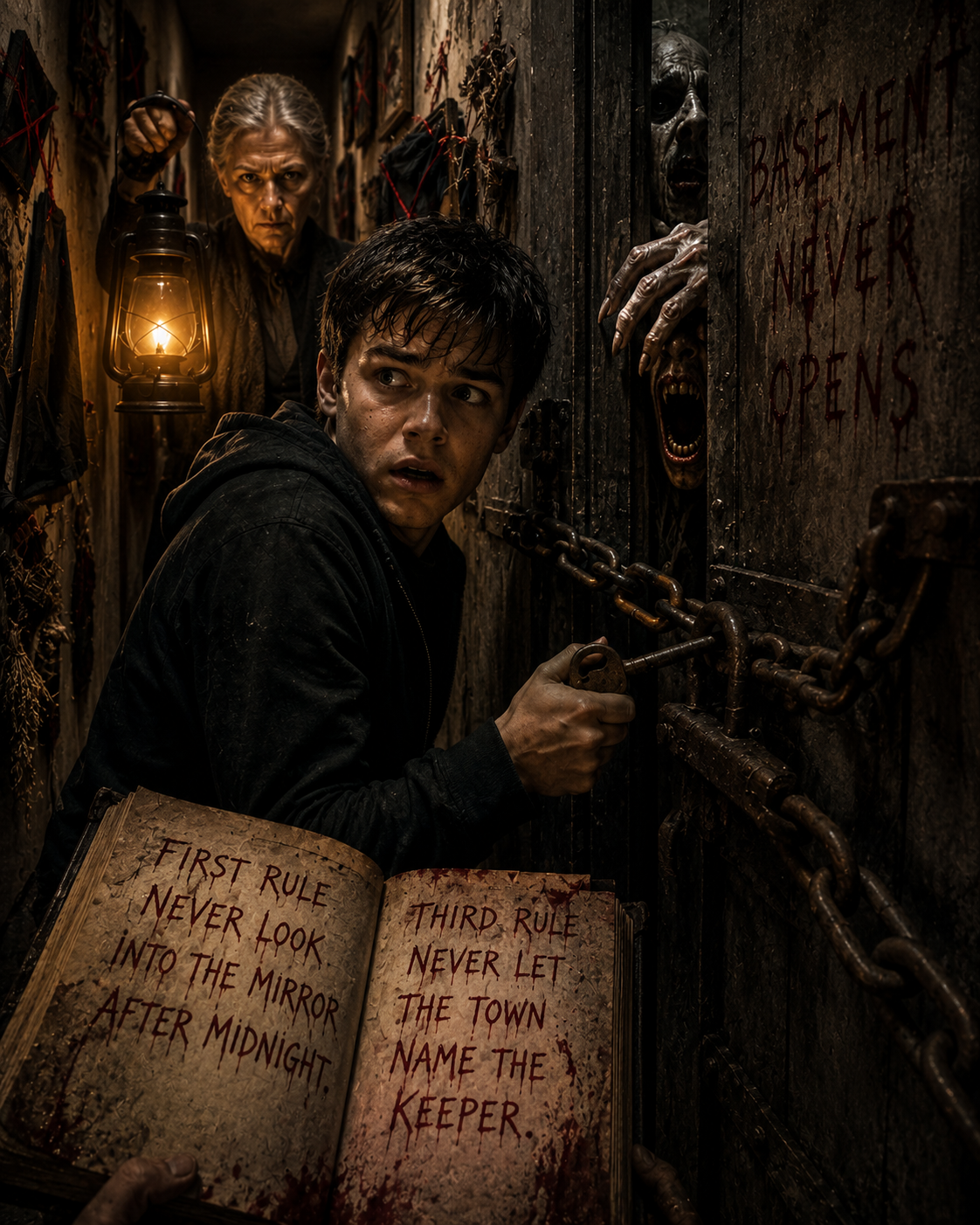
NEVER LOOK INTO THE MIRROR AFTER MIDNIGHT.
He read it the night his mother left him in the woods.
She did not hug him goodbye. She did not explain why the road had no cell service, why the GPS died three miles back, or why every window on the old house had been boarded shut from the inside. She only gripped the steering wheel until her knuckles went white and stared straight ahead while rain crawled down the windshield like dirty fingers.
“Mom,” Liam said, his backpack tight against his chest. “What is this place?”
Her jaw trembled.
“Listen to Martha,” she whispered.
Then she drove away.
No wave.
No brake lights lingering.
Just the black car swallowed by the trees.
The woman waiting on the porch was older than Liam expected. Martha Spencer stood bent but not weak, one hand wrapped around a stripped wooden cane, her gray hair pinned tight against her skull. Her eyes were pale and sharp, the kind that made a boy feel searched instead of seen.
“Inside,” she said.
Liam looked at the woods behind him.
Martha’s voice hardened. “Don’t look back.”
He stepped over the threshold, and the air changed.
Outside, the forest smelled like rain and mud. Inside, the house smelled like old smoke, wet wood, rusted nails, and something sour beneath the floorboards. The hallway was narrow. A yellow bulb flickered overhead. Every mirror in the house was covered with black cloth. Small bells hung upside down from the ceiling beams. Bundles of dried garlic, animal bones, red thread, and wax seals dangled along the walls like warnings left by people who had learned too late.
Martha handed him a mold-stained notebook.
The cover said:
RULES FOR SURVIVAL.
“Read,” she said. “Obey. Don’t ask questions you aren’t ready to survive.”
The first page said never step into the hallway when the lights were off.
The second said never look into the mirror after midnight.
The third page had been torn out.
Liam looked up.
Martha was already gone.
Her bedroom door closed at the end of the hall with a soft click, and the house went still.
That first night, the hall light died at 11:43.
Liam was sitting on the edge of his bed with the rulebook open across his knees. When the bulb blinked out, the hallway became a long black throat. At first there was nothing. Then came a slow dragging sound across the floorboards.
Not footsteps.
Something lower.
Something wet.
It moved past his door, paused, and scraped once against the wood.
Liam held his breath.
Three knocks followed.
Knock.
Knock.
Knock.
Patient. Certain. Almost polite.
When the hallway light flickered back on, the sound was gone. But the rulebook had opened by itself.
Fresh red words crawled across the page as if an invisible hand were writing them.
WHEN THE LIGHTS GO OUT, DO NOT WONDER WHY.
DO NOT TRY TO SEE.
DO NOT LET IT SEE YOU FIRST.
Liam did not sleep.
By morning, he understood one thing: his mother had not sent him to Martha Spencer’s house because she trusted the old woman.
She had sent him there because she was afraid of something worse.
The next day, Liam walked four miles into town.
Willow Creek was the kind of town that looked abandoned even when people were inside it. A gas station. A grocery store. A bar with a broken neon sign. A sheriff’s office with one patrol cruiser parked outside and a flag hanging limp in the gray wind.
The moment Liam said Martha Spencer’s name, everyone changed.
At the grocery store, the woman behind the counter turned pale and walked into the back room.
At the gas station, the clerk said the pumps were down even though every display was lit.
At the bar, conversations stopped when he entered. A man in a hunting jacket stared at Liam’s muddy shoes, then looked away like the boy carried disease.
Liam left after one warm soda and a silence that felt staged.
As the door closed behind him, he heard someone mutter, “That’s the boy she traded.”
He stopped.
The voices inside went quiet again.
On the road back, rain fell hard enough to blur the trees. Liam cut through a field and found an old man sitting outside a rusted tin shed with a woodstove glowing behind him. One of the man’s legs ended above the knee. A handmade crutch leaned against his chair.
“You’re from Spencer House,” the man said.
Liam froze.
“How do you know?”
The old man laughed without humor. “Because nobody walks that road unless they’ve been sent or sentenced.”
Liam stepped closer. “What’s in that house?”
The man looked toward the trees.
“A door.”
“To what?”
“To whatever waits under us when the world gets thin.”
Liam thought of the dragging sound in the hallway.
The old man tapped his missing leg. “I lived near that place once. One night the basement opened. I got lucky. It only took this.”
“Why doesn’t anyone help?”
“Because the house is a nail, boy. It pins the thing down. Pull the nail, and the whole county bleeds.”
Liam’s mouth went dry.
“And Martha?”
The old man’s eyes sharpened. “Martha is not the monster. She is what the town uses instead of courage.”
That evening, Liam returned to the house soaked and shaking.
Martha waited on the porch.
“Town was friendly?” she asked.
Liam said nothing.
Her eyes moved to the woods behind him.
“You heard something out there.”
“A song.”
Martha’s fingers tightened around her cane. “If it sings in a voice you love, run. If it sings in your own voice, bite your tongue until you taste blood.”
“Why?”
“Because pain belongs to you. The song doesn’t.”
That night, curiosity broke him.
At 11:57, Liam sat in his room staring at the black cloth over the mirror. His phone had no service, but the clock worked. Each minute changed with impossible precision.
11:58.
The house creaked.
11:59.
The hallway light dimmed.
Midnight.
Liam pulled the cloth away.
At first, the mirror showed only his room. His bed. His backpack. His pale face.
Then his reflection smiled.
Liam did not.
The reflection lifted its left hand when Liam’s right hand hung frozen by his side. Its mouth widened too far. Its eyes filled black from edge to edge.
The mirror clouded with fog.
Behind the reflection appeared another hallway — wet walls, hanging lights, a locked basement door wrapped in chains.
Then the reflection raised one finger to its lips.
Shhh.
The glass cracked.
A single word formed in the fog.
HUNGRY.
The lights went out.
Liam threw the cloth back over the mirror and fell to the floor, crying without sound.
In the dark, something inside the mirror breathed.
He woke before dawn with blood on his sheets.
His lip was split. His tongue ached where he had bitten it in his sleep. Four deep scratches ran along the wall beside the covered mirror. At the foot of the bed, the rulebook lay open.
The words were smeared and wet.
THE MIRROR IS OPEN.
THE DOOR IS STILL CLOSED.
IT WILL LOOK FOR ANOTHER WAY.
By morning, Martha was gone.
Liam searched the house, moving slowly past the covered mirrors. In the hallway, he found a locked basement door he had not noticed before. It was thick oak, burned along the edges, wrapped with six iron chains and sealed with black wax, salt, and red thread.
A metal plate on the door had been scratched until the words were nearly unreadable.
BASEMENT NEVER OPENS.
Then Liam smelled lavender.
His mother’s perfume.
“Baby?”
The voice came from below.
Liam stopped breathing.
“Mom?”
A sob rose through the floorboards.
“Liam, please. I’m cold. She locked me down here.”
The first lock clicked open by itself.
His hands moved before his mind could stop them.
“Mom?”
“Please, sweetheart.”
The second lock opened.
The third.
A thin gray hand pushed through the gap beneath the door. Too long. Too jointed. The nails were dark and curved, scraping the toe of Liam’s shoe.
He stumbled back.
Martha’s cane struck the floor behind him like a gunshot.
“DROP THE LOCK.”
Liam turned.
Martha stood there soaked in rain, her face colorless with fear.
“That’s my mother,” Liam said.
“No,” Martha said. “That’s what it found in you.”
She shoved him aside and slammed the locks back into place, one after another, faster than her old hands should have moved. The thing behind the door began to cry in his mother’s voice, then scream in something that was not human.
“Liam,” it wailed. “Don’t listen to her.”
Martha pressed her palm to the wood.
“Silence,” she whispered.
The house went dead quiet.
Then Martha turned on him.
“You think love makes a voice true?” she hissed. “That thing wears memory like skin. It will say whatever opens the door.”
“My mother brought me here.”
“Yes.”
“Why?”
Martha’s expression changed.
For the first time, Liam saw something worse than anger.
Shame.
“Because I am dying,” she said. “And the house needs a living keeper.”
The words hit him harder than the cane had.
“No.”
“The rules choose blood. The town knows. Your mother knows. Everyone knows.”
“My mother traded me?”
Martha looked away.
“She made a bargain before you were born.”
Liam backed into the wall.
Outside, thunder moved over the trees.
Martha reached under her collar and removed a tiny black key from a silver chain. She placed it in his palm.
“This opens the safe in the parlor. Inside is the last letter your mother wrote before fear made her a coward.”
Liam closed his fist around the key.
“Why would I believe you?”
“Because liars give comfort,” Martha said. “I am giving you work.”
That afternoon, while Martha repaired the basement seals with red thread, Liam opened the parlor safe.
Inside was a sealed envelope.
His name was written on it in his mother’s hand.
The paper shook in his fingers.
Liam,
If you are reading this, then Martha told you enough to hate me.
You deserve to.
The Spencer house has held the thing under Willow Creek for one hundred and seventeen years. Every keeper is chosen from the bloodline that first opened the basement. My grandmother carried it. Then Martha. Then me.
I ran.
I thought if I left town, if I married outside the county, if I never spoke Martha’s name, the house would forget me.
It didn’t.
When you turned sixteen, mirrors started fogging in our apartment. You sang in your sleep with a voice that was not yours. I found red thread under your pillow.
The house had found you.
Martha said if I brought you before the new moon, there was still a chance to teach you the rules. If I waited, it would take you without teaching.
I am sorry.
I was not brave enough to stay.
Your mother,
Rachel
At the bottom of the envelope was one more item.
A photograph.
Martha, much younger, stood on the porch beside Liam’s mother as a teenager. Between them stood a sheriff, a county judge, and three members of Willow Creek’s town council.
Behind them was the basement door, open just wide enough to show darkness.
On the back, someone had written:
TRANSFER HEARING — CLOSED SESSION — COUNTY RECORDS SEALED.
Liam stared at the photo until rage replaced fear.
This was not just a haunted house.
It was a system.
A town had chosen silence. Officials had sealed records. Families had passed terror down like property. Martha had become the face of a crime everyone else benefited from forgetting.
That night, the rulebook started bleeding.
Not metaphorically.
Real blood seeped from the torn third page, dripping onto the parlor floor in slow, heavy drops. Martha grabbed the book and stitched the page with red thread, muttering words Liam did not understand. Every time the needle pierced the paper, the lights flickered.
“What was rule three?” Liam demanded.
“You don’t need to know.”
“Yes, I do.”
Martha’s hands stopped.
The basement chains rattled.
She looked older than the house.
“Rule three,” she said, “was never let the town name the keeper.”
“What does that mean?”
“It means the keeper must choose. If the town names you, you become a sacrifice. If you name yourself, you become the lock.”
Liam looked at the bleeding page.
“That’s why no one says your name.”
Martha smiled bitterly.
“They say it when they need me. They don’t say it when they want to sleep.”
The house shuddered.
From below came his mother’s voice again.
Then his own.
Then Martha’s.
Three voices braided together, singing a lullaby that made the windows sweat.
Martha grabbed an axe from beside the fireplace and pushed it into Liam’s hands.
“Tonight the stitches fail.”
“What do we do?”
“You decide.”
“Decide what?”
“To run and let Willow Creek become a feeding ground.” Her eyes burned. “Or stay and rewrite the rule.”
“How?”
“With blood. With witness. With a name.”
Before he could answer, blood struck the ceiling.
One drop.
Then another.
Martha looked up.
“Open the safe again,” she said.
“There’s nothing else.”
“There is a false bottom.”
Inside the safe, beneath the letter, Liam found a stack of county records, a VHS tape, and a small cassette recorder.
Martha had kept evidence.
Bodycam footage from a sheriff’s deputy who entered the house twenty-three years earlier and never came out whole. Closed-session transfer documents. Witness statements from townspeople who admitted the house protected Willow Creek. A county attorney’s note recommending that the Spencer property be excluded from future emergency response maps.
At the bottom was a tape labeled:
RACHEL — LAST VISIT.
Liam pressed play.
His mother’s voice filled the parlor.
“I am not asking forgiveness,” Rachel said. “I am leaving this so my son knows I was afraid, not innocent. Martha begged me to stay. The town threatened to have Liam taken by court order if I refused the transfer. They told me one child was better than all children. They told me the Spencer women had always understood duty.”
Her breath broke.
“I believed them long enough to become what they needed. Then I hated them too late.”
The floor groaned beneath Liam.
The basement locks snapped one by one.
Martha did not move.
“Listen to me,” she said. “When the door opens, it will show you what you want. Your mother. Freedom. Revenge. Don’t take any of them.”
“What do I take?”
“The book.”
The basement door exploded inward.
Darkness poured into the hall like water.
From inside it crawled the faceless thing — gray, slick, too tall, folded wrong at every joint. Its head was smooth until the skin split open in a circular mouth lined with tiny teeth. Around its wrists hung scraps of red thread and old hair. It smelled like basement mud, lavender perfume, and rotting meat.
It spoke in Rachel’s voice.
“Baby, come here.”
Liam raised the axe.
The thing laughed with his own mouth.
Martha stepped between them.
“No,” Liam shouted.
The creature struck her.
She hit the wall hard enough to crack the wood. Blood ran from her mouth, dark and thick.
The ceiling bells rang by themselves.
The rulebook flew open on the floor.
The torn third page gaped like a wound.
Liam understood then.
The rulebook was not a list.
It was a contract.
And contracts could be amended.
He dropped the axe, grabbed the book, and pressed his bleeding palm to the torn page.
“My name is Liam Vale,” he said.
The creature stopped.
The house leaned toward him.
“I was brought here by fear. I was lied to by my mother. I was hidden by this town.” His voice shook, but he forced it louder. “I name myself witness, not sacrifice.”
The red thread on the page snapped.
Martha looked up from the floor, eyes wide.
“Liam—”
He kept going.
“I name Martha Spencer keeper by choice, not curse. I name Rachel Vale guilty and afraid, but not erased. I name Willow Creek responsible.”
The creature screamed.
Every covered mirror in the house shattered behind its cloth.
Liam’s blood spread across the page, forming new words.
A KEEPER MAY NOT BE GIVEN.
A KEEPER MUST SPEAK.
A TOWN THAT BENEFITS FROM SILENCE SHARES THE LOCK.
Outside, sirens began to wail.
Not ghost sirens.
Real ones.
The cassette recorder on the table had been transmitting.
Martha’s old emergency radio, hidden in the safe, had broadcast Rachel’s confession and Liam’s words across the county emergency channel.
Willow Creek heard everything.
The creature lunged.
Liam did not run.
He shoved the bleeding rulebook into its open mouth.
The thing convulsed. Red thread shot from the pages, wrapping around its jaw, its wrists, its long wet throat. Martha, bleeding and broken, dragged herself to the basement door and whispered the sealing word.
This time Liam said it with her.
“Silence.”
The creature was pulled backward into the dark.
The door slammed shut.
All six locks snapped closed.
Then the house went still.
By dawn, Willow Creek was outside.
Sheriff’s deputies. State police. County investigators. News vans from three cities. Neighbors who had avoided Martha’s name for decades now stood in the mud, pale and exposed, while bodycam footage captured every boarded window, every sealed record, every chain on the basement door.
The county judge from the photograph was dead.
Two council members were not.
They were arrested before noon.
The local sheriff tried to call the house a “private family matter.” Then the VHS tape played on the evening news, showing his predecessor dragging a screaming young Martha into the property line while town officials watched.
No one called it folklore after that.
They called it conspiracy.
They called it child endangerment.
They called it unlawful confinement, falsified records, obstruction, and criminal negligence.
But Liam knew none of those words were large enough.
Martha spent three weeks in the hospital.
Liam visited every day.
The first time she woke, she looked at him and said, “You should have run.”
He sat beside her bed.
“So should you.”
Her mouth trembled.
It was not a smile, but it was close.
“What did the house do after?”
“It’s quiet.”
“For now.”
“No,” Liam said. “Different quiet.”
State investigators sealed the Spencer property. Experts came. Priests came. Engineers came. Psychologists came. Everyone tried to name the basement in language that made them feel safer.
Sinkhole.
Toxic gas.
Shared delusion.
Ritual site.
Unstable structure.
Liam let them talk.
The rulebook stayed with him.
Not hidden.
Not worshiped.
Filed as evidence first, then returned under court order because no one could explain why the pages continued bleeding whenever a public official lied near it.
One year later, Willow Creek held a public hearing in the high school gym.
The room was packed.
People cried. People denied. People apologized in careful sentences that avoided blame. Then Liam stood up with Martha beside him, thinner now, walking with a new cane.
He opened the rulebook on the podium.
The room went silent.
“My mother was wrong,” he said. “Martha was wrong sometimes too. But this town was worse. Because she carried the horror, and you carried the excuse.”
No one spoke.
Liam turned to the first page.
The old rule was still there.
Never step into the hallway if the lights are off.
The second rule remained too.
Never look into the mirror after midnight.
But the third page had changed.
It no longer bled.
It read:
NO CHILD WILL EVER BE GIVEN TO THE HOUSE AGAIN.
Behind him, Martha closed her eyes.
The lights in the gym flickered once.
Only once.
Far away, somewhere beneath the boarded Spencer house, something scratched against a locked door.
Liam heard it.
Martha heard it.
Maybe half the town heard it too.
But this time no one looked away.
And for the first time in one hundred and seventeen years, every person in Willow Creek said her name out loud.
Martha Spencer.
Not witch.
Not monster.
Not rumor.
Keeper.
Witness.
The woman they had used.
The woman who had survived.
And when Liam walked home that night under a clean cold moon, every dark window in town reflected only what stood in front of it.
Nothing more.
Nothing hungry.
Nothing waiting to be invited.
Still, before bed, Liam covered the mirror.
Not because he was afraid.
Because some rules are not cages.
Some rules are scars that remember how close the door came to opening.