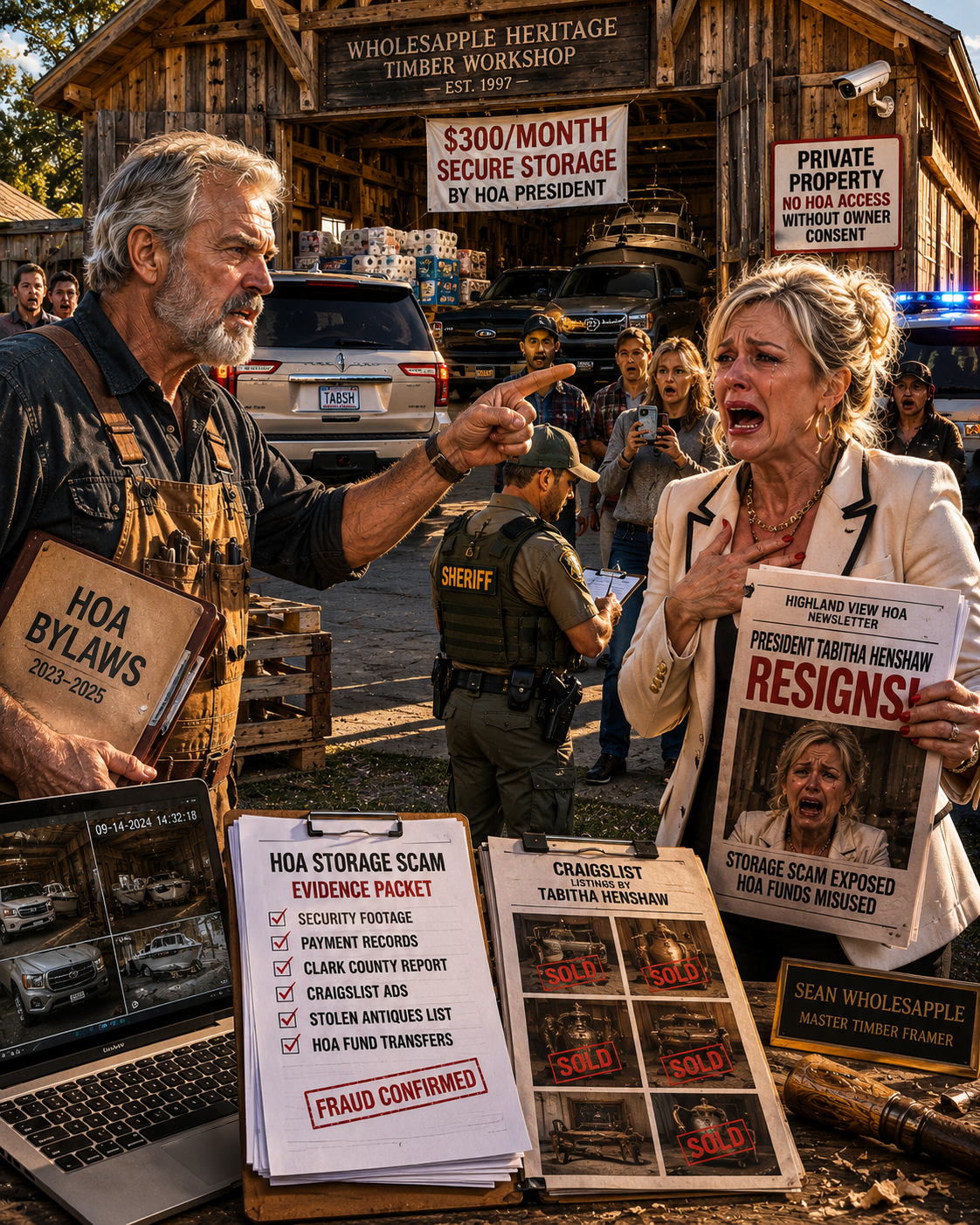
THE HOA PRESIDENT TURNED MY WORKSHOP INTO HER PRIVATE PARKING LOT — THEN COUNTY RECORDS, SECURITY PHOTOS, AND ONE BYLAW EXPOSED THE STORAGE SCAM THAT MADE HER CRY IN HER OWN NEWSLETTER
THE HOA PRESIDENT TURNED MY WORKSHOP INTO HER PRIVATE PARKING LOT — THEN COUNTY RECORDS, SECURITY PHOTOS, AND ONE BYLAW EXPOSED THE STORAGE SCAM THAT MADE HER CRY IN HER OWN NEWSLETTER
The first thing I saw inside my workshop was a pearl-white Lincoln Navigator parked where an 1881 Quaker meetinghouse frame was supposed to be.
The second thing I saw was my grandfather’s workbench shoved against a wall beneath two pallets of Costco paper towels.
The third thing I saw was my lead apprentice sitting on a sawhorse with a forty-three-page incident log in his lap, looking at me like a man who had been waiting six weeks to hand me a loaded weapon.
“Mr. Whitaker,” he said quietly, “I photographed everything.”
That was the moment the Highland Ridge HOA president stopped being an annoyance and became a criminal investigation.
My name is Owen Whitaker. I am sixty-six years old. I have spent forty-two years building and restoring timber-frame barns, churches, smokehouses, grist mills, and meetinghouses across western North Carolina. I own 214 acres outside Burnsville, land my grandfather bought in 1924 after cutting timber in West Virginia long enough to come home with a bad shoulder, a pocketful of savings, and the kind of stubbornness that becomes inheritance.
The workshop sits on the south rise above Shaw Creek Hollow. Ninety feet long. One hundred and thirty feet wide. Forty feet to the ridge beam. I built it in 1997 with white oak posts, pegged mortise-and-tenon joinery, antique glass windows salvaged from a 1905 Methodist meetinghouse, and bay doors tall enough to swallow a barn frame whole.
It was not a garage.
It was not community storage.
It was not an HOA amenity.
It was my life’s work.
So when I came home from a six-week lecture series in Vermont and found Tabitha Hensley’s Navigator parked inside it beside her husband’s Ford F-150, her son’s Audi Q5, a lake boat, a snowmobile trailer, and two pallets of bulk groceries, I did not raise my voice.
That has never been my way.
I walked across the concrete floor, past the scattered rafters of the Quaker meetinghouse project, past the bank-barn beams that had been pushed aside, past the 1798 dogtrot frame components that my daughter had labeled by hand, and I asked one question.
“How long?”
Linus Brimhall, my senior apprentice of twenty-two years, closed his paperback and stood.
“Since the second morning after you left.”
Outside, late October dusk settled over the hardwood ridge. The workshop windows reflected the last gold of the day, but inside, the place looked violated. Not destroyed. Worse. Used casually by someone who believed my absence was the same thing as permission.
Linus handed me the log.
“Tabitha told me you authorized it.”
“I did not.”
“I know.”
“Why didn’t you move anything?”
His face tightened.
“Because she threatened Mrs. Whitaker’s rental cottage inside Highland Ridge. Said she would file HOA enforcement actions every week until your daughter lost access for visiting students.”
That was the first betrayal.
My wife, Caroline, owned a small mill-worker cottage on the edge of Highland Ridge, a luxury subdivision built near our land in 2018. She used it for quilt students who traveled from out of state. That cottage gave her one HOA vote. One vote should never make a woman’s family land vulnerable to extortion, but people like Tabitha Hensley understand systems. They do not need legal authority if they can create fear.
Linus continued.
“She also brought residents here.”
I looked up.
“What residents?”
“Highland Ridge residents. At least eleven visits. She showed them parts of the building. Called them reserved bays.”
The air seemed to leave the workshop.
“She was renting space?”
Linus nodded once.
“Three hundred dollars a month, from what I heard.”
I looked at the vehicles again. The boat. The pallets. The Audi. The stolen floor space. The displaced frames. The false confidence of it all.
Then Linus said the sentence that changed everything.
“I have photographs every fifteen minutes from every day she entered.”
I turned toward him.
“Every day?”
He pointed toward the rafters.
“I added two security cameras after the first week. I backed everything up on three drives. I wrote down plate numbers, times, names, and what she carried in and out.”
For the first time since I walked through that bay door, I smiled.
Not because I was happy.
Because evidence has a smell, and I could finally breathe it.
I locked the workshop from the outside with my own key, walked to the house, and called my attorney, Jonah Vogel.
Jonah had represented my family for twenty-seven years. He had written my apprenticeship contracts, my restoration agreements, my easement filings, my property-line affidavits, and once, during a boundary dispute with a developer from Asheville, a letter so polite it made a man cry before lunch.
He answered on the second ring.
“Owen.”
“Jonah, someone turned my workshop into a parking lot.”
There was a pause.
“Someone stupid?”
“An HOA president.”
“Ah,” he said. “The deluxe version of stupid.”
By six o’clock, my daughter Margot arrived with her husband, Caleb, and their two children in the back seat. Margot had trained under me from the time she was seventeen and now ran operations for the shop. She had my patience, Caroline’s eyes, and my grandfather’s ability to make fools explain themselves without realizing they were confessing.
She walked into the workshop, took in the scene, and said, “Dad, don’t touch anything.”
“I wasn’t going to.”
“I mean emotionally either.”
That was Margot.
We spent three hours documenting every inch.
Ninety-six photographs. Video walkthroughs. Measurements of the storage footprint. Close-ups of tire tracks. Photos of the Costco pallets. Photos of the scattered frame pieces. Photos of the security cameras Linus had installed. Photos of the bay-door lock, which had been scratched around the latch. Photos of a printed “Highland Ridge Storage Access Schedule” lying on the passenger seat of Tabitha’s Navigator.
That paper had my workshop address printed at the top.
Under it were fourteen names.
Fourteen monthly payment columns.
Three hundred dollars each.
Margot held the paper with gloved fingers and looked at me.
“This isn’t just her parking her car.”
“No.”
“This is a business.”
“Yes.”
“She used your building as inventory.”
I nodded.
Then she turned the paper over.
On the back, in Tabitha’s handwriting, were four words.
DO NOT SHOW OWNER.
Margot took one photo.
Then another.
Then she whispered, “Oh, she’s done.”
That night, Caroline and I sat at the kitchen table with the incident log, the storage schedule, the security photos, and five years of Highland Ridge newsletters. Caroline kept everything. Quilt patterns, grocery lists, old funeral programs, utility bills, HOA newsletters. She believed paper remembered what people tried to revise.
Tabitha Hensley had become HOA president in June 2023 after a reasonable retired teacher named Cordelia Ames stepped down for health reasons. Within ninety days, the newsletters doubled in length. The dues rose. Compliance walks began. The phrase “community standards” appeared so often it started to feel like a threat.
Caroline found the first notice at 11:14 p.m.
December 2023.
COMMUNITY STORAGE RESOURCE AVAILABLE TO MEMBERS IN GOOD STANDING.
Exclusive secure storage opportunity at a community-affiliated heritage facility adjacent to Highland Ridge. Limited access. Priority scheduling. Contact HOA president for details.
No address.
No owner name.
No authorization.
The notice appeared every quarter after that.
Twenty-two months.
Caroline set the newsletter down, her face calm in the way that meant trouble was sharpening itself behind her eyes.
“Owen,” she said, “she has been advertising your workshop for almost two years.”
I looked at the stack of newsletters.
The kitchen clock ticked.
The house smelled like coffee and woodsmoke.
Caroline reached for the Highland Ridge bylaws binder.
“What are you doing?”
She flipped to a tab marked MEMBERSHIP MEETINGS.
“Reading.”
That was when she found Section 9.4.
Any voting member may call a special meeting upon written petition of a simple majority of members for the purpose of removing an officer for misconduct, conflict of interest, fraud, or misuse of association communication channels.
Caroline tapped the page.
“There.”
One bylaw.
One sentence.
One loaded hinge in the wall Tabitha thought she controlled.
The next morning, Jonah drove up from Burnsville with a leather portfolio, a yellow legal pad, and a thermos of black coffee. He sat at our kitchen table with me, Caroline, Margot, and Caleb, then read everything without speaking.
The incident log.
The newsletters.
The security photos.
The storage schedule.
The “do not show owner” note.
When he finished, he removed his glasses.
“Tabitha Hensley has problems.”
“How many?”
“State fraud. Civil conversion. Trespass. Unfair and deceptive trade practices. Potential mail fraud because the newsletter went out through USPS. Potential wire fraud if she took electronic payments. Potential stolen-property charges if any resident items are missing.”
Margot leaned forward.
“Missing?”
Jonah tapped the storage schedule.
“If she was charging residents to store property in Owen’s workshop, where are their actual items?”
That question changed the room.
We had seen Tabitha’s property.
We had not seen theirs.
By four that afternoon, Margot and I were sitting in the kitchen of Cynthia Porter, Lot 42, Highland Ridge. Cynthia was sixty-eight, a retired county health nurse, widow of a cabinetmaker, and owner of a thirteen-year-old beagle named Amos who slept under the table while she listened.
I told her I owned the workshop.
I told her I had not authorized community storage.
I told her I had found her name on a schedule in Tabitha’s vehicle.
Cynthia folded both hands around her coffee mug.
“I have paid Tabitha Hensley three hundred dollars a month for fourteen months.”
“What were you storing?”
“My husband’s woodworking tools. Eleven planes. Twenty-six chisels. A Stanley Bedrock 605 jointer that belonged to his father.”
My stomach sank.
“They were not in my workshop.”
Cynthia looked at me for a long time.
“Mr. Whitaker,” she said softly, “where are my husband’s tools?”
“I don’t know yet.”
She did not cry.
Some people think not crying means a thing does not hurt.
Those people have never watched an Appalachian widow stand, walk to a cabinet, pour two fingers of bourbon, drink it in one swallow, and return to the table with her hands steady.
“What do you need me to sign?”
By Friday, we had nine sworn statements.
Rufus Whitman had paid nine months to store a 1969 Indian motorcycle his father brought home from a Marine deployment.
Alda Branson had paid eighteen months to store her grandmother’s hope chest, her family Bible, and her late mother’s wedding china.
Casper Eldridge had paid eight months to store a Browning shotgun engraved with his family crest.
Other residents listed quilts, trunks, antique tools, clocks, furniture, and boxes of family records.
None had ever been allowed direct access.
All had been told the same line.
“The heritage facility requires HOA-coordinated visits.”
None of their property was in my workshop.
Jonah found the rest through county records and the North Carolina Secretary of State.
Blue Ridge Heritage Vault LLC.
Registered by Tabitha Hensley in April 2023.
Business purpose: secure storage of antique, vintage, and heritage personal property.
Registered address: Mountain View Self Storage, West Asheville.
Three climate-controlled units.
When the Attorney General’s office subpoenaed the facility records, the truth opened like a rotten wall.
Some resident items were still there.
Others had been sold through Craigslist, Facebook Marketplace, and two antique dealers. Payment records showed more than forty-one thousand dollars in resale proceeds. Combined with monthly storage fees, Tabitha’s scheme exceeded one hundred fourteen thousand dollars.
She had taken money from her neighbors for storage in my workshop.
She had never stored their property there.
She had moved many of their heirlooms to her own LLC units.
Then she had sold some of them.
The same newsletter she controlled had advertised the lie.
That was the hidden truth.
But the emotional injustice was worse.
Cynthia had been paying to protect her dead husband’s tools while Tabitha sold them.
Alda had paid to preserve six generations of family history while her Bible sat in someone else’s storage unit.
Rufus had paid to keep his father’s motorcycle safe while Tabitha treated it like inventory.
People think fraud is numbers.
It is not.
Fraud is memory theft with invoices attached.
Caroline filed the Section 9.4 special meeting notice the following Monday.
She walked into the HOA office with the petition, the bylaw page, and a sealed envelope containing Jonah’s summary. Tess Belden, the HOA secretary, opened the envelope, read for nine minutes, and looked up with a face gone pale.
“Mrs. Whitaker,” Tess said, “I want to resign from the board and sign your petition.”
By sunset, three more board members had done the same.
By Friday, Caroline had signatures from fifty-one households, more than enough to compel a special meeting.
The agenda went out by certified mail.
SPECIAL MEMBER MEETING.
RECALL OF HOA PRESIDENT TABITHA HENSLEY.
NOVEMBER 12.
7:00 P.M.
HIGHLAND RIDGE CLUBHOUSE.
Tabitha received her copy Monday at 1:15 p.m.
At 1:38, she drove her Lincoln Navigator to Caroline’s quilt studio.
Caroline was sewing when Tabitha stepped into the doorway.
I was standing on the porch outside, close enough to hear.
“Caroline,” Tabitha said, voice thin. “This has gotten out of hand.”
Caroline did not look up from the machine.
“No, Tabitha. It has gotten into writing.”
“I can explain.”
“You can explain to your attorney.”
“You don’t understand what this will do to the community.”
The sewing machine stopped.
Caroline finally looked up.
“The community is the people you stole from.”
Tabitha’s face changed.
Not remorse.
Calculation.
“You should be careful,” she said. “You still own property inside Highland Ridge.”
Caroline smiled.
It was not warm.
“And you still published a quarterly fraud notice using bulk mail.”
Tabitha left.
That evening, Jonah called.
“She just made another mistake.”
“What now?”
“She filed a counter-complaint claiming Caroline is undermining the community storage program.”
I waited.
Jonah laughed softly.
“She admitted the program exists.”
Mistake one.
Mistake two came Saturday evening when Tabitha visited Cynthia Porter and offered to refund all prior payments if Cynthia “declined to participate in the political circus.”
Cynthia recorded the entire twenty-three-minute conversation on her phone.
One-party consent state.
Jonah forwarded the audio to the Attorney General’s office.
The reply came in five minutes.
WITNESS TAMPERING.
Mistake three came Sunday when Tabitha’s husband, Richard, showed up at my porch in a tweed jacket, wool tie, and the face of a man who had finally understood that marriage is not a legal defense.
“I didn’t know,” he said.
“About which part?”
“The LLC. The payments. The sales. I knew she parked things in your building. I thought she had permission.”
“From whom?”
He looked away.
“That is why I am here.”
Richard signed a cooperating witness statement that afternoon.
Mistake four came Tuesday when Tabitha stood on Tess Belden’s porch for nineteen minutes ringing the doorbell and knocking. Tess did not answer. Her security camera recorded everything.
By Tuesday night, the FBI’s Asheville resident office had opened a parallel federal case.
The special meeting took place Wednesday.
By 6:45 p.m., the Highland Ridge clubhouse was full.
Residents stood against the walls. Others sat in folding chairs with envelopes, photos, bank statements, and printed newsletter pages in their laps. Cynthia Porter sat in the fourth row, back straight. Rufus Whitman sat beside her with both hands folded over his cane. Alda Branson held a photograph of her grandmother’s hope chest.
Caroline sat in front with Jonah.
I sat behind her with Margot, Caleb, Linus, and the apprentices.
Two county sheriff’s deputies stood by the west wall. A senior deputy from the North Carolina Attorney General’s Consumer Protection Division stood by the east wall with a court reporter. Special Agent Ardith Reynolds from the FBI sat near the aisle. A reporter from the Asheville Citizen-Times sat in the seventh row with a notebook open.
Tabitha arrived at 6:53.
Coral blazer. White pants. Gold sandals. Perfect hair.
Then she saw the room.
Her smile died at the door.
She walked toward the podium as if muscle memory might still protect her.
Tess Belden stepped in front of it.
“Mrs. Hensley,” Tess said, “under the bylaws, the chair of a recalled board does not preside over her own recall proceeding.”
Tabitha blinked.
“Excuse me?”
“Please sit down.”
For three seconds, no one moved.
Then Tabitha sat.
That was the first public crack.
Tess opened the meeting at 7:01. She read the bylaw. Section 9.4. Then Caroline took the podium.
My wife brought three pages.
Not a speech.
Evidence.
Page one summarized Blue Ridge Heritage Vault LLC.
Page two listed the fourteen resident victims and payments collected.
Page three listed recovered items and missing items.
Her voice did not shake.
“Members of Highland Ridge,” she said, “Tabitha Hensley used the HOA presidency, the HOA newsletter, and a private LLC to defraud residents under the false claim that my husband’s workshop was an authorized community-affiliated storage facility. It was not. It never was. Owen Whitaker owns that building. He gave no permission. The residents who paid were not customers. They were victims.”
A low sound moved through the room.
Not outrage yet.
Recognition.
People looking at the woman beside them and understanding that the private shame they had carried was shared.
Caroline continued.
“I move that the membership recall Tabitha Hensley as HOA president and install a transitional board pending criminal proceedings.”
Tess said, “Seconded.”
The vote was called by household.
Eighty-nine votes in favor.
Zero against.
One abstention.
Richard Hensley’s lot.
At 7:36 p.m., Tabitha Hensley was no longer HOA president.
At 7:37, the Attorney General’s deputy stepped forward with a folded document.
“Tabitha Anne Hensley, you are under arrest.”
The room went silent.
The charges were read clearly: mail fraud, wire fraud, conspiracy to defraud, receiving stolen property, and witness tampering.
The handcuffs went on at 7:38.
Tabitha did not speak as she passed Cynthia Porter.
She did not look at Alda Branson.
She did not look at Caroline.
She did look at me.
Just once.
There was confusion in her face, as if she still could not understand how land, paper, photographs, and bylaws had beaten her.
The clubhouse door closed behind her at 7:41.
At 7:42, Cynthia began clapping.
Then Rufus.
Then Alda.
Then the whole room stood.
I have heard standing ovations in university halls after lectures on joinery. I have heard applause at barn raisings when the last bent went up. None of it sounded like that room.
That was not celebration.
That was people getting their dignity back.
The December newsletter became the final public punishment.
Under the bylaws, the outgoing president was required to deliver the quarterly newsletter copies to the Burnsville post office for mailing. The new acting editor, Tess Belden, prepared the issue with Jonah’s review and the Attorney General’s approval.
Thirty-six pages.
Pages one through six carried the investigation.
Restoring Trust at Highland Ridge: The Blue Ridge Heritage Vault Scheme.
Photographs of recovered items.
Quotes from residents.
A timeline of Tabitha’s notices.
The federal indictment number.
And on page four, inside a black-bordered box, was Tabitha’s signed apology letter.
Title:
I Am Sorry.
Three hundred seventy-two words.
Her own handwriting at the bottom.
Her own name beneath the confession.
On December 1, while out on bond, Tabitha was required to pick up ninety printed newsletters from the HOA office and deliver them to the post office.
The Citizen-Times photographer waited across the street.
Tabitha arrived at 8:40, loaded the boxes into her Lincoln Navigator, and drove to the Burnsville post office. She carried the first box inside at 9:15.
The clerk opened the top copy.
He turned to page four.
He read the apology.
Then he looked at her.
He did not say a word.
He stamped the box and placed it on the outgoing conveyor.
At 9:21, Tabitha walked out, stopped on the sidewalk, covered her mouth with her right hand, and cried.
One minute and forty-three seconds.
The photographer captured forty-seven images.
The next morning’s front page showed Tabitha with the post office sign behind her, eyes closed, shoulders dropped, mouth covered.
The headline read:
HOA PRESIDENT CRIES OVER HER OWN NEWSLETTER
People asked later if I felt sorry for her.
No.
I felt sorry for Cynthia, who waited two years to learn where her husband’s tools went.
I felt sorry for Alda, who had to identify her grandmother’s hope chest from inventory photos.
I felt sorry for Rufus, who cried alone in his driveway when his father’s motorcycle came home.
I felt sorry for every person who believed a community leader because decent people do not naturally assume the woman editing the newsletter is stealing heirlooms behind their backs.
Tabitha pled guilty in February.
Five years in federal prison.
One hundred forty-two thousand dollars in restitution.
Blue Ridge Heritage Vault LLC dissolved by court order.
The recovered items came home slowly.
Cynthia’s Stanley Bedrock 605 jointer was found in Tennessee. The man who had bought it on Craigslist accepted restitution and drove it back himself. Cynthia made coffee. They talked about fathers and tools for an hour.
Rufus’s Indian motorcycle came back from a vintage dealer near Marion. He started it in his driveway and sat on it for thirty minutes without riding anywhere.
Alda’s hope chest returned in April. Her family Bible came back the same day. She placed it on her dining room table and did not move it for nine weeks. In May, she invited us to dinner and served the meal on her mother’s wedding china.
She never said Tabitha’s name once.
Highland Ridge rewrote its bylaws in March.
No board member may operate a business marketed through HOA communication channels. No paid community resource can be advertised without verified ownership, written authorization, and independent review. HOA dues were capped. The newsletter adopted a fact-checking policy.
Caroline’s Section 9.4 quilt now hangs in the clubhouse.
Purple thread on cream and gold.
BY THE BYLAWS, WE REMEMBER.
The workshop reopened in December.
It took six days to reassemble what Tabitha had pushed aside. Linus, Margot, Caleb, the apprentices, and I worked from sunrise until dark, fitting labeled timbers back into order, checking joinery, repairing dents, sanding scuffs from the layout floor.
The 1881 Quaker meetinghouse frame went up at its new site outside Burnsville in February.
When the last peg drove home, I thought of my grandfather.
He had bought land because he wanted one place in the world where no man could move his tools without asking.
A century later, an HOA president tried.
She lost.
Not because I shouted.
Not because I threatened.
Not because I turned anger into spectacle.
She lost because Linus took photographs. Margot measured everything. Jonah read statutes. Caroline read bylaws. Cynthia recorded the truth. Tess opened the meeting. And ninety households finally understood that paper only protects you if someone is willing to read it out loud.
Last night, I walked through the workshop after everyone had gone home.
The floor was clean.
The frames were stacked properly.
My grandfather’s workbench stood where it belonged beneath the south windows.
Outside, the ridge held the last blue light of evening. A barred owl moved across Shaw Creek Lane and disappeared into yellow poplar.
I stood in the open bay door for a long time, listening to the creek.
Then Caroline came up behind me and slipped her hand into mine.
“Still angry?” she asked.
“Yes.”
“Good.”
I looked at the workshop.
At the beams.
At the tools.
At the place my family built and defended with photographs, records, and one sentence hidden inside a bylaw binder.
“No,” I said after a while. “Not angry.”
“What then?”
I smiled.
“Documented.”
Caroline laughed softly.
The sound filled the workshop better than any apology ever could.
And this time, every car parked inside belonged there.