FAKE HOA COPS BEAT A RETIRED FBI AGENT ON HIS OWN FRONT LAWN — BUT THEY NEVER REALIZED 12 HIDDEN CAMERAS, BODYCAM FOOTAGE, AND A FEDERAL TAKEDOWN TEAM WERE ALREADY RECORDING THE ENTIRE OPERATION
FAKE HOA COPS BEAT A RETIRED FBI AGENT ON HIS OWN FRONT LAWN — BUT THEY NEVER REALIZED 12 HIDDEN CAMERAS, BODYCAM FOOTAGE, AND A FEDERAL TAKEDOWN TEAM WERE ALREADY RECORDING THE ENTIRE OPERATION
The first baton hit me behind the left shoulder before I could even turn away from my Jeep.
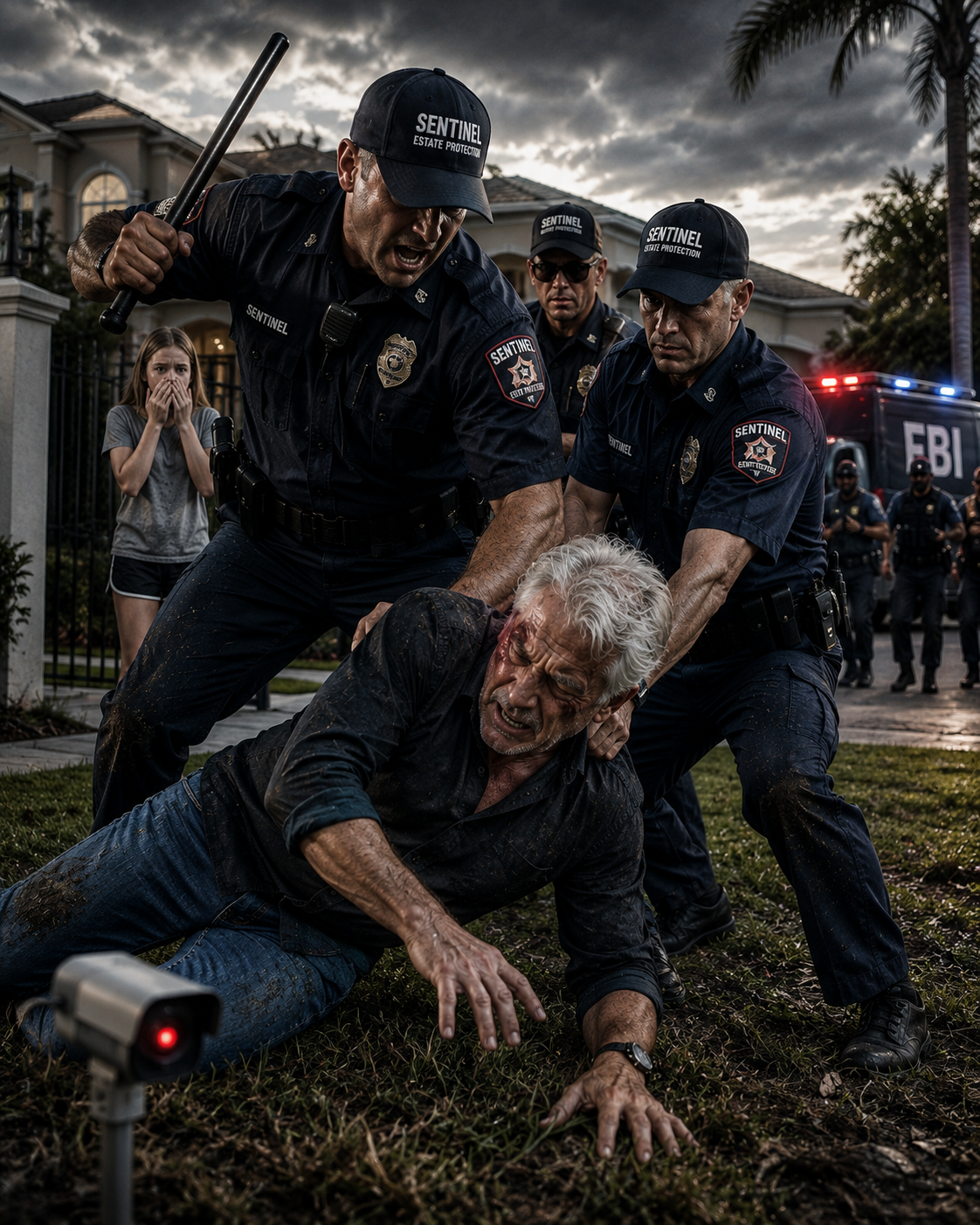
I dropped to one knee in my own front yard, face inches from the wet St. Augustine grass, while a man in a fake sheriff’s uniform stood over me and said, “You are under HOA arrest.”
That was his first mistake.
His second was believing the cameras on my porch were the only cameras watching him.
My name is Hayes Talmadge. I am sixty-two years old, retired from the Federal Bureau of Investigation after twenty-eight years, and for the last six of those years I served as Special Agent in Charge of the FBI Tampa Field Office. I had spent most of my career investigating the kind of men who put on badges, real or fake, and decided a uniform gave them permission to hurt people.
So when four private security guards rolled into my driveway in a golf cart with a flashing blue strobe, wearing navy uniforms designed to look like Manatee County sheriff’s deputies, I did not misunderstand what was happening.
They were not there to enforce an HOA rule.
They were there to make an example out of me.
What they did not know was that twelve hidden cameras around my property had been recording for weeks. A surveillance van two houses down had been recording since sunrise. A second federal tactical team was parked three streets away. Their bodycams were already live. Every word, every step, every hand movement, every illegal command, every blow was being streamed to a secure Department of Justice server in Washington.
Inside my kitchen, my wife Estelle stood beside the spice rack with one hand near a hidden panic switch.
Our granddaughter, May, was not home.
That part mattered most.
May was fourteen, freckled, sharp-eyed, and braver than most adults I had arrested. She was our daughter Annalie’s only child. Annalie died of pancreatic cancer three years earlier, and after the funeral, May came to live with us whenever her father, Beck, was offshore working on oil rigs in the Gulf.
May still kept her mother’s ceramic mugs lined along our kitchen windowsill. She still laughed into her sleeve the way Annalie used to. She was the closest thing Estelle and I had to a second chance.
That was why, when Sentinel Estate Protection started harassing residents in Bayou Pines Estates, I paid attention.
Bayou Pines was the sort of gated Florida community that looked harmless from the outside. White stucco homes. Palm-lined medians. Heated clubhouse pool. HOA newsletters printed on thick paper. Golf carts at sunset. Retired executives complaining about mailbox colors. The kind of place where people told themselves nothing truly ugly could happen because the lawns were too green.
But ugly things had been happening for years.
The first story came from our neighbor Ruben Halverson, eighty-one, a retired pipefitter and Vietnam veteran. Sentinel guards pulled him from his Cadillac at the front gate because his radio was “too loud.” They handcuffed him beside his own car. One guard told him he was being detained under “community enforcement authority.”
There was no such authority.
Ruben cried when he told me. Not because of the pain. Because of the humiliation.
After that, the stories came faster.
An elderly widow fined $3,700 because a Sentinel guard claimed her porch light was “suspiciously bright.” A retired school principal stopped while walking her dog after dusk. A disabled veteran ordered out of his truck at the mailbox kiosk. A seventy-six-year-old man shoved against his garage door because he questioned a landscaping citation.
Every victim said the same thing.
The uniforms looked real.
The badges looked real.
The fear was real.
Sentinel Estate Protection was owned by Spencer Voorhees, a former Florida Highway Patrol trooper who had been forced out after an excessive-force complaint. He had reinvented himself as the private muscle behind HOAs across three counties. His wife, Carlin Voorhees, was president of the Bayou Pines HOA. Polished, blonde, cold smile, perfect nails, always standing near the coffee urn at community board meetings like she owned the air inside the clubhouse.
Together, they had built something worse than an HOA scam.
They had built a private intimidation machine.
I took my first folder to the FBI Tampa office in September.
Special Agent Camille Morrison met me in the same conference room where I had once briefed civil rights cases. She had taken my old job after I retired. Tall, calm, Gainesville-born, impossible to rattle. She opened the folder, read for twenty minutes, and never touched her coffee.
Inside were twelve victim statements, photographs of Sentinel uniforms, copies of HOA citations, and screenshots from residents’ doorbell cameras. Every citation looked official enough to scare someone. Every uniform patch was close enough to law enforcement to confuse the public. Every detention crossed a line.
Camille closed the folder.
“Hayes,” she said, “Spencer Voorhees is already on our radar.”
“I assumed.”
“He is dangerous.”
“I assumed that too.”
She looked at me over the folder. “How deep does this go?”
“I don’t know yet.”
“Then keep digging.”
So I did.
By December, I had twenty-three folders. By February, the Bureau had identified Sentinel contracts in fifteen gated communities across Manatee, Sarasota, and DeSoto counties. By March, forensic accountants had traced nearly three million dollars in “security assessment fees” through HOA dues, shell LLCs, and accounts linked to Spencer and Carlin Voorhees.
Then former federal magistrate Theron Ailey walked across my lawn one Sunday afternoon with a manila accordion file under his arm.
He was seventy-six, neat as a trial transcript, wearing khaki shorts and an old fishing shirt. He set the file on my patio table and said, “Hayes, there are six deaths.”
I did not speak for a moment.
He opened the file.
Six elderly residents. Six Sentinel encounters. Six deaths ruled natural, accidental, or unrelated. Four death certificates signed by Dr. Garner Voorhees, the Manatee County medical examiner.
Spencer’s older brother.
The first case was Wilburn Hendricks, seventy-four, retired aerospace engineer. Detained by Sentinel over an unleashed Yorkie. Witnesses saw taser barbs in his shirt. The autopsy never mentioned them.
The second was Beatrice Lindeman, eighty-two, who collapsed after being locked in a clubhouse office for forty minutes over unpaid HOA fines.
The third was Marvin Quist, seventy-nine, a widower with a heart condition, found dead less than twelve hours after three Sentinel guards dragged him from his driveway.
The pattern was not messy.
It was clean.
Too clean.
That was when the case stopped being about fake cops.
It became about dead citizens, corrupted records, and a private security racket protected by people who thought age made their victims disposable.
I called Camille that night.
“We need exhumation orders,” I said.
She went quiet.
Then she said, “And we need them to make one undeniable move on camera.”
“I’ll be the move.”
“No.”
“Camille.”
“No, Hayes.”
“They’re already coming after me. Let them.”
“You are not twenty-eight anymore.”
“No,” I said. “But I am still useful.”
The line stayed silent.
I could hear her breathing.
Finally, she said, “I am not putting you in front of a baton unless we control every angle.”
“Then control every angle.”
That was how my home became a federal trap.
The Bureau installed twelve hidden cameras: under the porch eaves, inside the fake birdhouse Estelle hated, behind the license plate frame on my restored 1972 Jeep Wagoneer, inside a sprinkler head near the mailbox, beneath the copper porch light, and in two palm trunks along the driveway.
A white panel van parked two houses down in Theron’s driveway, supposedly owned by a pool-cleaning company. It held four surveillance specialists, directional microphones, redundant recording systems, and a direct line to the Tampa field office.
A second tactical team waited three streets away in an unmarked delivery van.
Estelle learned the emergency protocol in silence. Flip the switch behind the spice rack. Lock the laundry room door. Stay low. Do not open the front door. Do not call 911 unless Camille told her to.
May was harder.
She sat at the kitchen table with a glass of milk, a cookie untouched in front of her, and listened while I explained that bad men wearing fake uniforms might come to the house.
“Are they police?” she asked.
“No.”
“Are they pretending to be?”
“Yes.”
Her eyes narrowed.
“Mom would have hated them.”
That almost broke me.
“Yes,” I said. “She would have.”
“Then we beat them.”
I looked at Estelle.
Estelle looked at the window.
No one corrected May.
The final HOA notice arrived in a cream envelope with the Bayou Pines logo stamped in gold.
It claimed I owed $63,400 for nonconforming landscaping, obstruction of HOA enforcement, and failure to submit to “community protection review.” The last paragraph stated that under Bylaw 14.3, the HOA could authorize private enforcement personnel to enter my property and “effectuate physical compliance.”
I read it twice.
Then I pulled the recorded covenants from county records.
There was no Bylaw 14.3.
Carlin Voorhees had invented legal language and signed her name beneath it.
My attorney, Wynn Castellano, a retired federal prosecutor, called eleven minutes after I sent him the scan.
“Hayes,” he said, “this woman just wrote your RICO predicate act in cursive.”
“Good.”
“Do not sound pleased. She also authorized armed trespass onto your property.”
“Even better.”
“Hayes.”
“I know.”
“No, you don’t. Men like Spencer Voorhees escalate when embarrassed. He won’t send someone to serve papers. He will send someone to hurt you.”
“That’s what we need.”
Wynn exhaled. “I hate retired FBI agents.”
“Everybody does.”
“Stay alive long enough to testify.”
That became the rule.
Stay alive.
On Friday night, Camille called.
“They’re coming tomorrow morning,” she said. “Four-man Sentinel team. Eight o’clock. Your house.”
Estelle stood beside me at the kitchen sink, drying a plate that had been dry for two minutes.
“Does May know?” Camille asked.
“She’ll be in Bradenton by seven-thirty.”
“And Estelle?”
Estelle took the phone from me.
“I know my role, Camille.”
Camille’s voice softened. “I know you do.”
After we hung up, Estelle and I sat at the kitchen table without turning on the television. The house had the strange quiet of a place waiting for weather. May’s tennis racket leaned by the back door. Annalie’s photo sat near the window, our daughter smiling in a yellow sundress at a beach in Sarasota, one hand shielding her eyes from the sun.
Estelle reached across the table.
“You are going to let them hit you.”
“Yes.”
“I understand why.”
“I know.”
“I still hate it.”
“I know that too.”
She squeezed my hand.
“Be the door,” she said.
At 7:32 the next morning, Estelle drove May to her cousin’s house. May hugged me in the driveway before she left. She held on longer than usual.
“Grandpa?”
“Yeah?”
“Don’t do anything stupid.”
“I’ll do something controlled.”
“That sounds like FBI stupid.”
I laughed despite myself.
She pulled back.
Her eyes looked exactly like Annalie’s.
“Come home for lunch,” she said.
“I will.”
Estelle returned at 7:54. She went inside and stood near the spice rack.
At 7:55, I opened the hood of my Jeep.
The morning was already thick with Florida humidity. Thunderheads gathered over the palms. A mockingbird kept shifting songs in the live oak near the driveway. The grass was wet from sprinklers. Everything smelled like engine oil, cut lawn, and rain coming.
At 8:02, the Sentinel golf cart turned onto Bayou Drive.
Four men.
Navy uniforms.
Fake badges.
Blue strobe light.
The driver pulled into my driveway like he owned it.
He stepped out with a clipboard.
“Mr. Talmadge,” he said. “Sentinel Estate Protection. We are here to execute HOA Citation Enforcement Order Seventeen.”
His nameplate read D. KELLER.
I set my wrench on the fender.
“My name is Hayes Talmadge. I do not consent to your presence on my property. You are trespassing. Leave now.”
Keller smiled slightly.
“Sir, under Bayou Pines Bylaw 14.3, we are authorized to enforce physical compliance.”
“There is no Bylaw 14.3.”
His smile faded.
“You are under HOA arrest.”
“There is no such thing as HOA arrest.”
Behind him, the other three guards stepped off the cart.
One drew a baton.
One touched his taser.
One looked toward my front window, where he probably thought my granddaughter might be watching.
That was the moment I felt the case become personal in a way even federal procedure could not contain.
Keller stepped closer.
“Hands behind your back.”
“No.”
He swung.
The baton came down hard on my left shoulder. Pain flashed white behind my eyes. I went down to one knee, exactly where the sprinkler-head camera could see my face and his boots and the baton still in his hand.
I said clearly, “I do not consent. You are assaulting me on private property.”
The taser fired.
The probes hit my chest.
Electricity locked my muscles and slammed me backward into the grass.
Inside the house, Estelle flipped the switch.
Two houses down, the panel van went live to the takedown channel.
Three streets away, eight federal agents reached for their vests.
In Tampa, a DOJ server began receiving twelve camera feeds, four directional microphones, one van dashcam, and bodycam footage from the response team moving toward my street.
Keller stepped over me.
“Roll over.”
I could not move yet.
He bent with fake handcuffs in his left hand.
Then a voice cut across the yard.
“FBI! Hands where I can see them!”
Special Agent Drusen Crane came around the corner in a dark blue Ford Explorer, door already open before the vehicle stopped. He moved with three agents behind him, badges out, weapons low, controlled and clean.
The Sentinel men froze.
“Drop the baton.”
Keller looked over his shoulder.
“Drop it now.”
The baton hit the grass.
The taser followed.
The second van arrived seconds later. More agents poured into the cul-de-sac. Bodycams captured every angle. One team secured the guards. Another cleared the golf cart. A third moved toward the HOA office under separate warrant authority.
Keller lay face down in my grass with zip cuffs on his wrists.
His fake badge had fallen beside a sprinkler head.
One of the younger agents, Mara Donnelly, knelt beside me.
“Mr. Talmadge, you conscious?”
“I am annoyed.”
“That counts.”
“Shoulder. Chest. Taser barbs.”
“We’ve got you.”
From inside the house, Estelle appeared at the front window. She did not come outside until Crane signaled clear. When she reached me, she knelt in the grass and placed one hand on my face.
“You came home for lunch,” she whispered.
“Technically,” I said.
She cried then, quietly, angrily, with her forehead pressed to mine.
At 8:06, FBI agents arrested Spencer Voorhees at his home.
At 8:09, Carlin Voorhees was arrested at the Bayou Pines HOA office while drinking iced coffee from a stainless tumbler. Agents seized her phone, laptop, board records, financial ledgers, and a locked file cabinet containing unsigned settlement agreements for residents who had been injured by Sentinel.
At 8:14, teams in Sarasota and DeSoto counties arrested additional Sentinel guards.
By noon, thirty-one Sentinel employees, seven HOA board members, two HOA attorneys, and Dr. Garner Voorhees were in custody or under federal hold.
By three o’clock, the Florida Attorney General had filed emergency orders to suspend Sentinel’s license and initiate exhumation proceedings in three deaths.
I gave my statement from my front porch with an ice pack on my shoulder and bandages on my chest.
The grass still showed where my knee had gone down.
Camille called at 12:14.
“Hayes,” she said, “we have everything.”
I looked across the yard at the fake handcuffs sealed in an evidence bag.
“Good.”
“We also recovered bodycam footage from Sentinel.”
That surprised me.
“They wore cameras?”
“They did,” Camille said. “And they forgot the cloud account was still syncing.”
For a moment, I closed my eyes.
That was the clue that cracked the case wide open.
Sentinel’s own bodycam archive showed dozens of unlawful detentions across fifteen communities. Guards laughing after scaring elderly residents. Spencer Voorhees instructing employees to “lean hard on nonpayers.” Carlin telling a board member, “Fear is cheaper than litigation.” Dr. Garner Voorhees discussing one death as “manageable.”
But the worst clip was Ruben Halverson.
Eighty-one years old, standing beside his Cadillac at the gate, shaking in handcuffs while a Sentinel guard told him, “Nobody is coming for you, old man.”
At the public safety hearing six weeks later, that footage played inside the Tallahassee Senate chamber.
The room went silent.
Not political silent.
Human silent.
Ruben sat in the front row wearing his old Vietnam service pin. His hands trembled in his lap. Beside him sat Rosalyn Hendricks, widow of Wilburn Hendricks, the man who died after the Yorkie detention. She wore black and held a folded photograph of her husband.
When the footage ended, the commission chair, Senator Loretta Pickering, removed her glasses.
“Mr. Talmadge,” she said, “would you like to speak?”
I had not planned to.
But I stood.
“My name is Hayes Talmadge,” I said. “For twenty-eight years, I investigated abuse committed under color of law. This case is what happens when private power learns to imitate public authority. Sentinel did not protect communities. It hunted the people least able to fight back. The elderly. The widowed. The sick. The isolated. And it did so with the cooperation of HOA boards, attorneys, financial officers, and a medical examiner who helped make injuries disappear from paper.”
I turned toward Rosalyn.
“Wilburn Hendricks mattered.”
Her face crumpled.
“Beatrice Lindeman mattered. Marvin Quist mattered. Dorothy Halpern mattered. Ruben Halverson mattered when they put cuffs on him at the gate. Every resident who was told to be quiet, pay the fine, sign the settlement, or stay afraid mattered.”
I looked at the commissioners.
“A fake badge is not a costume. It is a weapon. And when a community board hands that weapon to violent men, the law should treat it exactly as seriously as the families in this room have always known it was.”
No one clapped.
That would have felt too small.
Instead, people stood.
One by one.
First Ruben.
Then Rosalyn.
Then the residents from Bayou Pines, Hammock Cove, Cypress Lakes, and every other community Sentinel had touched.
The chamber rose in silence.
That silence did what applause could not.
It gave the victims back their dignity.
The criminal cases took sixteen months.
Spencer Voorhees was sentenced to twenty-two years in federal prison for civil rights violations, racketeering conspiracy, obstruction, and charges tied to two deaths reclassified after exhumation.
Carlin Voorhees received twelve years for conspiracy, mail fraud, wire fraud, money laundering, and directing unlawful enforcement through the HOA.
Dr. Garner Voorhees received fifteen years for obstruction of justice, falsified death records, and conspiracy.
Thirty-one Sentinel guards received sentences ranging from three to nine years. Seven HOA board members received prison terms. Two attorneys were disbarred. Sentinel Estate Protection was permanently dissolved.
The civil settlement reached forty-one million dollars.
Most went to victims and families.
The rest became the Annalie Talmadge Civil Rights Project, named after my daughter. Estelle insisted on it. The project provides free legal help to Florida residents facing private security abuse, fake police impersonation, HOA-sanctioned intimidation, or color-of-law violations.
May helped design the logo.
She put a small ceramic mug in the corner, for her mother.
A year after the arrests, Bayou Pines elected a new HOA board.
Ruben Halverson became president.
His first act was to remove the fake enforcement bylaws and replace them with a one-page resident rights policy written in plain English.
His second act was to send me a handwritten card.
Hayes,
We are starting over. The gate is open. Coffee anytime.
Ruben.
I framed it.
It hangs in my office beside Annalie’s graduation photo and a still image from Camera Seven: the exact moment Keller’s baton dropped from his hand as the FBI came around the corner.
Not because I enjoy looking at the violence.
Because I believe in remembering the turn.
Every abuse story has one.
The moment power realizes it is no longer alone with its victim.
These days, my life is quieter.
I finished restoring the Jeep. Estelle and I walk the property at sunrise and sunset. Beck left offshore work and moved closer to May. May is fifteen now and says she wants to become a civil rights attorney, though last week she also considered forensic accounting after Camille told her that money trails catch more criminals than car chases.
Sometimes, at breakfast, May asks about the case.
Not the dramatic parts.
The human parts.
“Were you scared?” she asked once.
“Yes.”
“Even though the FBI was there?”
“Especially because the FBI was there.”
She frowned.
I buttered a piece of toast.
“Because when good people are watching, you have to become the evidence.”
She thought about that.
Then she nodded like she understood more than I wanted her to.
On the second anniversary of Annalie’s death, we held the first public clinic for the civil rights project in a church hall outside Bradenton. More than two hundred people came. Elderly couples with folders. Veterans with citations. Widows with trembling hands. Immigrants afraid to speak. Homeowners who had been told by private guards that no one would believe them.
Ruben sat at the welcome table.
Rosalyn Hendricks handed out coffee.
Theron Ailey reviewed documents with the patience of a judge who had waited too long to be useful.
Camille arrived near noon, no badge showing, just a woman in a navy suit carrying a box of intake forms.
At the end of the day, after everyone had left, May stood by the empty chairs and looked around the hall.
“Mom would have liked this,” she said.
Estelle put an arm around her.
“Yes,” she said. “She would have brought too many cookies.”
May laughed into her sleeve.
For one second, Annalie was in the room with us.
Not as grief.
As proof that something good can still grow from what tried to destroy you.
That night, back home, I walked out to the front lawn alone.
The grass had healed. The boot marks were gone. The sprinkler head camera had been removed. The fake birdhouse was still there because Estelle had decided, after everything, that she liked it.
The live oak shifted in a warm breeze.
Somewhere beyond the gate, a golf cart hummed past.
No strobe.
No fake badge.
No voice pretending private fear was public law.
I stood where I had fallen and looked at the porch light glowing over my front door.
Then I heard May inside the house, laughing at something Beck had said. Estelle answered from the kitchen. The sound moved through the open window and settled over the yard like mercy.
That was the final victory.
Not the arrests.
Not the footage.
Not the headlines.
The victory was ordinary life returning to a place where fear once parked a golf cart in the driveway and called itself authority.
I turned off the porch camera feed on my phone.
For the first time in two years, I did not check the angles.
I just went inside.