THE FOREST RANGER TOOK A $15,000 JOB WITH FIVE STRANGE RULES — THEN SECURITY CAMERAS, BLUE LIGHTS, AND A HIDDEN BIOTECH LAB EXPOSED WHY THE MONSTERS IN OLYMPIC FOREST WERE NEVER SUPPOSED TO ESCAPE
The first thing they told me was that the job paid fifteen thousand dollars for one hundred days.
The second thing they told me was that if I quit before the hundredth day, I might not make it home.
I should have walked out of that Seattle office the moment the interviewer slid the envelope across the table and refused to answer why a private company needed a forest ranger in a federal wilderness zone. But I was twenty-nine, drowning in debt, three months behind on rent, and tired of pretending pride could pay bills.
So I signed.
The man in the gray suit watched my pen move across the contract without blinking.
“Do you have family nearby?” he asked.
“No.”
“Anyone expecting regular contact?”
“My mother. Sometimes.”
He made a small note.
That was the first time I felt something cold move behind my ribs.
“What exactly am I guarding?” I asked.
He closed the folder.
“Olympic Forest Preserve,” he said. “Remote sector. Washington State. Observation duty. Report anomalies. Follow the rules.”
“What kind of anomalies?”
He smiled for the first time.
“You will be briefed on site.”
Three days later, a black Jeep picked me up before dawn outside my apartment. The driver was an older man with silver hair and a face like weathered stone. He did not introduce himself. He did not turn on the radio. We drove west for four hours, past towns that became gas stations, past gas stations that became logging roads, past logging roads that became mud and fog and walls of cedar so thick they looked less like forest than a locked room built by nature.
At 9:12 a.m., we stopped at a steel gate.
A sign read:
AUTHORIZED PERSONNEL ONLY
OLYMPIC FOREST PRESERVE
BIOTECH SOLUTIONS ENVIRONMENTAL RESEARCH DIVISION
Behind the gate, the forest rose black and green under a low gray sky.
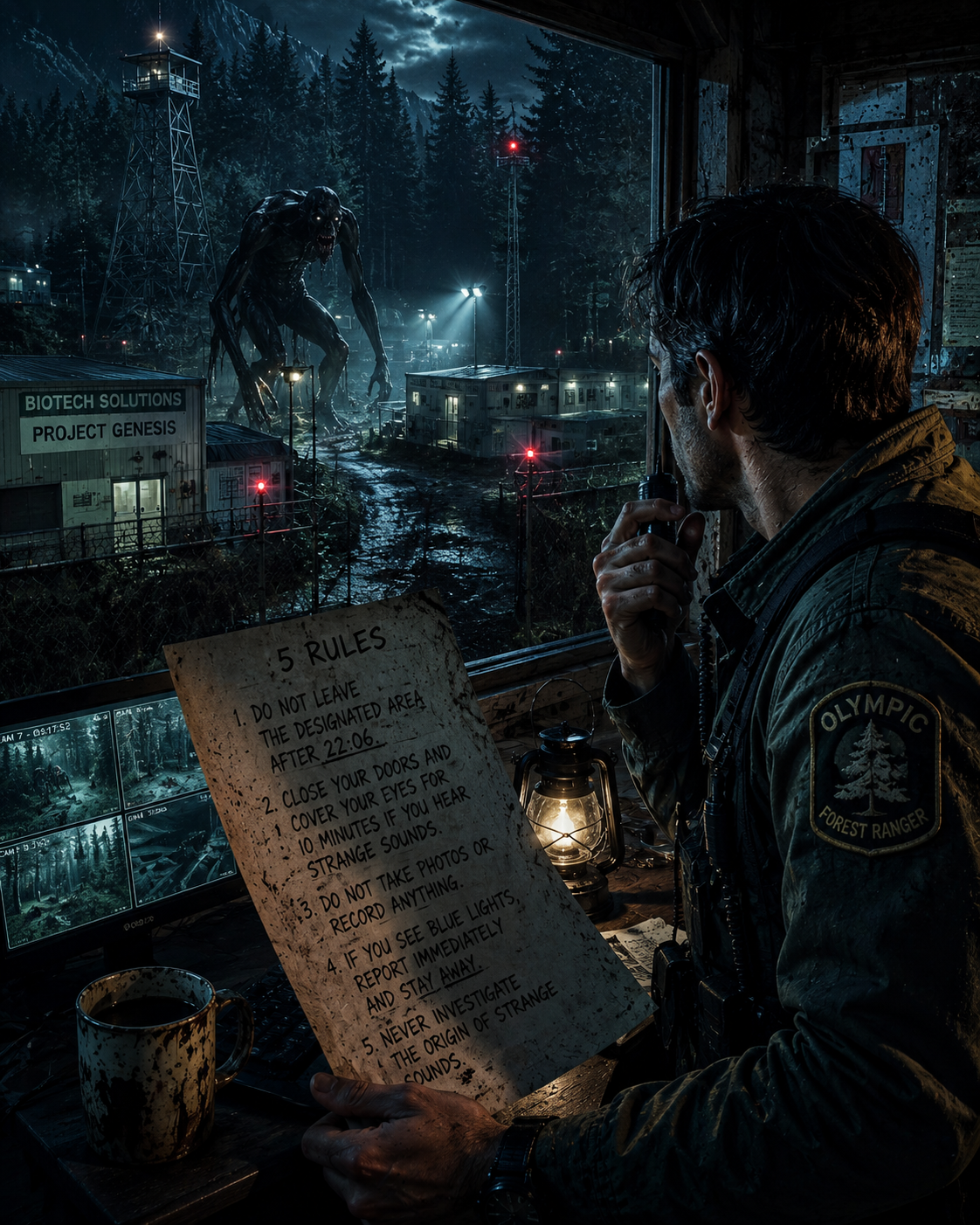
In the center of the clearing stood a metal observation tower, maybe one hundred feet tall, braced with steel legs and surrounded by floodlights, motion sensors, razor wire, and cameras disguised as birdhouses.
I noticed the cameras before I noticed the trees.
The driver killed the engine.
“Welcome home,” he said.
Those were the only words he spoke to me.
A bearded man in his forties met me at the base of the tower. He wore a brown ranger jacket and carried a rifle slung over one shoulder like it was part of his body. His eyes were tired in a way sleep could not fix.
“Caleb Reed?” he asked.
“That’s me.”
“Tom Barlow. I’ve been here three years.”
He shook my hand hard, then held it one second too long.
“If you want to live through the first week, listen more than you talk.”
A young woman came out from the supply shed carrying sealed food crates. She had dark hair, sharp eyes, and a green company uniform with no name tag.
“This is Mia Tran,” Tom said. “Logistics.”
Mia looked me over.
“Another one,” she said.
“Another what?” I asked.
She smiled without humor. “Optimist.”
Inside the tower, the living quarters were cleaner than I expected. Small kitchen. Two bunks. Weather monitors. Radio station. Wall maps. A narrow stairwell down to a locked basement control room. On the main desk sat a laminated card with five rules printed in black block letters.
Tom tapped the card.
“These are not suggestions.”
I read them.
RULE ONE: Do not leave the designated safe zone between 10:00 p.m. and 6:00 a.m.
RULE TWO: If you hear an unnatural cry, close all openings and cover your eyes for ten minutes.
RULE THREE: Do not photograph or record anything in the forest.
RULE FOUR: If you see blue light, report it immediately and move at least two hundred yards away.
RULE FIVE: Never investigate the source of strange sounds.
I looked up.
“You’re serious.”
Tom did not blink. “Dead serious.”
A male voice cracked through the radio.
“Tom, you got the new guy?”
Tom picked up the mic. “Yeah.”
The voice laughed once, tight and nervous. “Tell him curiosity gets people recycled.”
The radio clicked off.
“That was Jason Pike,” Tom said. “Systems tech. Works below.”
“Below what?”
Tom looked toward the locked stairwell.
“Everything.”
My first night began at 6:00 p.m.
By sundown, fog had filled the clearing. The trees disappeared trunk by trunk until the tower seemed to float in a gray ocean. I sat at the desk with the radio, a logbook, and a pistol Tom had placed beside the coffee maker without explanation.
At 9:00 p.m., the forest roared.
Not like a bear. Not like a cougar. Not like any animal I had heard in training videos or hunting clips.
It was low, metallic, and huge.
The sound traveled through the tower legs and into my teeth.
Rule two.
My hands shook as I closed the window vents, pulled the blackout curtain, sat on the floor, and covered my eyes.
For ten minutes, the forest came alive.
Metal slammed somewhere far away. Machinery groaned. Something screamed with a human throat and an animal’s lungs. Then came a rhythmic sound like a large gate opening underground.
When my timer ended, everything was quiet.
Too quiet.
I opened the curtain.
The forest stood still under the moon.
But on the outside of the glass, ten feet above the ground, were three fresh scratch marks.
Long.
Deep.
Wet at the edges.
I wrote my first log entry with a hand that would not stop trembling.
DAY 1. FIRST ROAR AT 2100 HOURS. METALLIC IMPACTS. MACHINERY. HUMAN-LIKE SCREAM. SCRATCHES ON THIRD-STORY WINDOW. RULES ARE REAL.
By day five, I had learned the official script.
Every morning at 6:00 a.m., I had to radio command and say one sentence.
“Night shift completed. No incident to report.”
No matter what happened.
No matter what I heard.
No matter what touched the tower.
On day seven, I found the first footprint.
It was near the edge of the fifty-yard safe zone, pressed deep into wet soil. Four toes. Each longer than my hand. Claw marks like curved knives. It led toward the tower and then vanished as if whatever made it had stepped upward into the air.
Tom found me crouched over it.
“Don’t stare too long,” he said.
“What made this?”
“Rule five.”
“That’s not an answer.”
“It’s the only answer that keeps you breathing.”
I stood up. “What are we really doing here?”
Tom looked through the trees, jaw tight.
“We’re not rangers.”
“Then what are we?”
His eyes moved to the cameras hidden in the branches.
“Bait with radios.”
On day twelve, Jason disappeared.
The official word was maintenance transfer.
Mia brought the announcement with canned food and bottled water, her mouth pressed into a hard line.
“Jason is off-site for system repairs,” she said.
Tom stared at his coffee.
I said, “He told me yesterday the readings didn’t match.”
Mia’s face changed.
Just for a second.
“What readings?” she asked.
“He said the perimeter sensors were detecting things inside the safe zone and outside it at the same time.”
Tom stood. “Drop it.”
“No.”
“Caleb.”
“No. People don’t vanish into maintenance transfers overnight.”
Mia set the food crate down quietly.
“Here they do.”
That night, at 8:47, Jason’s voice came from the woods.
“Caleb!”
I froze at the desk.
It came again, closer.
“Please, man. I’m hurt. Open the door.”
Tom had gone to sleep in the lower bunk. I woke him without speaking.
His face drained when he heard it.
Jason sobbed outside the tower.
“They left me out here. I can’t feel my legs.”
Tom grabbed my arm.
“Cover your eyes.”
“That’s Jason.”
“No,” Tom said. “That’s something that learned him.”
The pounding started.
Not on the door.
On the window.
Thirty feet above the ground.
“Caleb,” Jason’s voice whispered against the glass. “Why won’t you look at me?”
I covered my eyes until my fingers hurt.
After twenty minutes, the voice stopped.
Then something laughed.
It was not Jason anymore.
“Smart boy,” it said.
In the morning, the tower window was cracked.
On the outside of the glass, written in mud or something darker, were two words.
NOT LONG.
On day twenty-five, I found Jason’s shoe prints.
They started behind the supply shed and ran toward a sinkhole I had never seen before. His right shoe had a torn heel. I knew that because Jason had joked about it the only time I met him downstairs.
The prints ended at the lip of the hole.
At the bottom, half-buried in black mud, was a strip of white lab coat.
The air rising from the hole smelled like ammonia, burnt plastic, and wet fur.
When I told Tom, he sat down like someone had cut the strings inside him.
“They said he was transferred,” I said.
Tom looked at me.
“Transferred means fed.”
The truth came in pieces after that.
Biotech Solutions was not running an environmental study. The preserve was not a preserve. The tower was not an observation post.
It was a human lure placed at the center of a containment field.
The monsters in Olympic Forest were not legends. They were not aliens in the trees or old gods under the moss.
They were engineered.
On day sixty-two, I broke rule three.
I used my phone to photograph the tower from outside and zoomed in on the image.
The picture revealed what my eyes had missed: hidden antennas, thermal cameras, directional microphones, blue-light emitters mounted in the trees, and a second entrance built into the foundation behind a fake panel.
I had been watched from every angle since the Jeep arrived.
The next morning, Tom asked, “Did you do anything unusual yesterday?”
“Like what?”
He looked exhausted.
“Command flagged movement.”
“They’re watching us.”
He almost smiled. “You’re just now understanding that?”
“Why didn’t they fire me?”
“Because they need you.”
That night, I broke rule five.
At 8:15 p.m., the roar came early. Instead of shutting the curtains, I opened a narrow slit and looked into the forest.
A massive camouflaged gate stood where trees had been the previous afternoon.
Not hidden by magic. Hidden by design.
Fake trunks. Netting. Projection screens. Black metal arms folding backward as blue light spilled through the opening.
The sound of machinery filled the clearing.
Then something stepped out.
It stood nearly ten feet tall on bent hind legs, built like a wolf forced into the shape of a man. Its shoulders were too high. Its arms hung too long. Two small horn-like ridges curved back from its skull. Its eyes glowed a cold chemical blue.
It lifted its head and sniffed.
Then it turned directly toward the tower.
Toward me.
I dropped the curtain and slid down the wall, shaking so hard I could barely breathe.
At dawn, I went below.
The hidden door opened with the code 2847.
Jason’s last note had included those numbers.
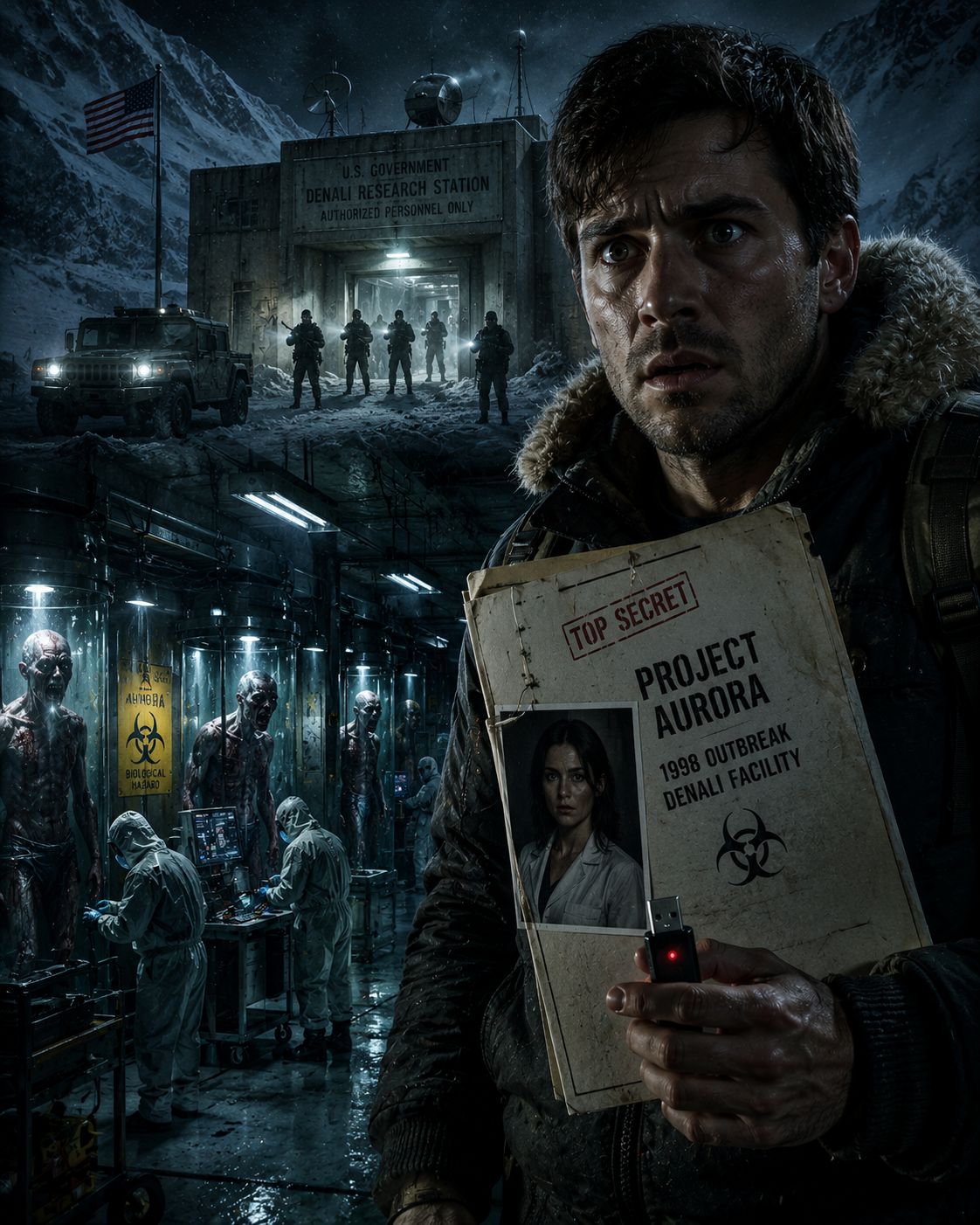
Behind the panel was a corridor lit by fluorescent tubes, descending into a facility so large it made the tower above it feel like a lookout booth over a city.
The underground complex stretched beneath the forest in sealed sections. Glass labs. Steel corridors. Quarantine bays. Holding tanks filled with blue liquid. Creatures suspended behind reinforced glass.
One tank held a serpent with folded wings.
Another held something like a bear whose skin flickered in and out of visibility.
In the largest chamber, a multi-headed animal floated in a green suspension bath, each head shaped from a different species, each pair of eyes closed as if dreaming of violence.
On a desk in an unlocked office, I found the file.
BIOTECH SOLUTIONS
PROJECT GENESIS
CLASSIFIED CONTINUITY BRIEF
My mouth went dry as I read.
Project Genesis had officially begun in 2019, but the biological work dated back decades. The company had obtained nonhuman genetic material from a classified federal archive and used it to modify native animal DNA. The goal was battlefield adaptation. Remote terrain control. Biological deterrence.
The language was clean.
The results were not.
SUBJECT I-203: CANIS REGALIS. Wolf-line hybrid. Approximate intelligence of a human child aged ten. Mimicry capabilities. Pack learning observed.
SUBJECT A-791: URSUS CRYSTALLINUS. Bear-line hybrid. Dermal hardening. Intermittent camouflage response.
SUBJECT Z-458: NOCTURNAL RAPTOR. Aerial predator. Sound imitation. Night-hunting capacity.
SUBJECT T-600: CEPHALO-FELID STRAIN. Flexible tissue architecture. Can compress through openings less than four inches wide.
Then I reached the red page.
INCIDENT REPORT — JUNE 15, 2024.
TWELVE GENESIS SUBJECTS BREACHED PRIMARY CONTAINMENT.
OUTER FOREST PERIMETER HOLDS TEMPORARILY.
HUMAN ANCHOR PRESENCE REQUIRED TO MAINTAIN SUBJECT LOCALIZATION.
RANGER PROGRAM APPROVED.
I read it twice before I understood.
We were not there to guard the forest.
We were there to keep the escaped things close.
The creatures had learned people meant food, sound, attention, warmth. Biotech placed rotating human staff in the tower to keep the subjects circling the preserve instead of moving toward towns.
I found Jason’s name on another page.
NONCOMPLIANT STAFF TRANSFERRED TO FIELD RESPONSE TESTING.
Below it were five names.
Jason Pike was the last.
I was next.
Tom was waiting when I climbed back into the tower.
His rifle was on the table.
“You went down,” he said.
“I know everything.”
“No,” he said quietly. “You know enough to get killed.”
“Jason tried to expose them.”
Tom closed his eyes.
“Jason was braver than me.”
“They murdered him.”
“They released him into Sector C and called it termination of contract.”
I felt sick.
“Mia knows?”
“Mia knows more than either of us.”
As if summoned, Mia arrived before noon with supplies and a split lip she tried to hide.
I pointed to it. “Who did that?”
She looked at Tom.
Then at me.
“Dr. Marcus Noll.”
The name sat between us like a loaded weapon.
Tom’s voice dropped. “Project director.”
Mia opened her supply crate. Under the canned food, she had hidden a small black drive.
“Jason copied footage before they took him,” she said. “Security cameras. Blue-light deployment. Feeding runs. Lab logs. Everything.”
“Why give it to me?”
“Because they searched me yesterday.” Her voice shook for the first time. “They know someone has it. If they find it on me, I disappear.”
“Then we send it out.”
Tom laughed once, bitter. “There’s no signal.”
“There is from the ridge,” Mia said. “Past the north perimeter.”
Tom stared at her.
“That’s outside the safe zone.”
“I know.”
“That’s where I-203 hunts.”
“I know that too.”
The Jeep returned the next morning.
Dr. Marcus Noll stepped out wearing a charcoal coat, thin glasses, and the calm expression of a man who had practiced moral distance until it became a second skin. He looked around the tower like he owned the air.
“Mr. Reed,” he said. “We need to discuss your recent curiosity.”
I said nothing.
Noll smiled. “Curiosity is not a flaw. It is why civilization advances. But unmanaged curiosity creates liability.”
He took me below through the official entrance.
He wanted to impress me.
That was his mistake.
He showed me the incubation chamber with eggs the size of barrels. He showed me the DNA lab where green-coded genetic strings twisted across transparent screens. He showed me the containment wing where creatures watched us from behind glass with intelligence I did not want to recognize.
Finally, he took me into the deepest room.
Inside a vertical tank floated a living being unlike anything in the forest.
Not a monster.
A prisoner.
It was nearly seven feet tall, silver-gray, thin, humanoid, with a large skull and black eyes that stayed open under the fluid. Cables ran into its spine, neck, and chest. Its fingers twitched slowly in the blue liquid.
“What is it?” I asked.
“Our source material,” Noll said.
“It’s alive.”
“Technically.”
“How long?”
“Seventy years.”
I turned to him.
“You kept a conscious being in a tank for seventy years?”
His face did not change.
“We preserved a resource.”
In that moment, the entire facility changed shape in my mind.
The creatures in the forest were not the first victims.
They were children of a theft.
A chained intelligence had been harvested for decades, its biology spliced into animals, its pain refined into weapons, its offspring released and hunted when they became inconvenient.
The being’s black eyes shifted toward me.
Not by much.
Enough.
Inside my head, not as a voice but as pressure, came one sentence.
OPEN SKY.
I stumbled back.
Noll watched me carefully.
“Did you feel something?”
“No.”
His eyes sharpened.
“You did.”
That evening, they came for me.
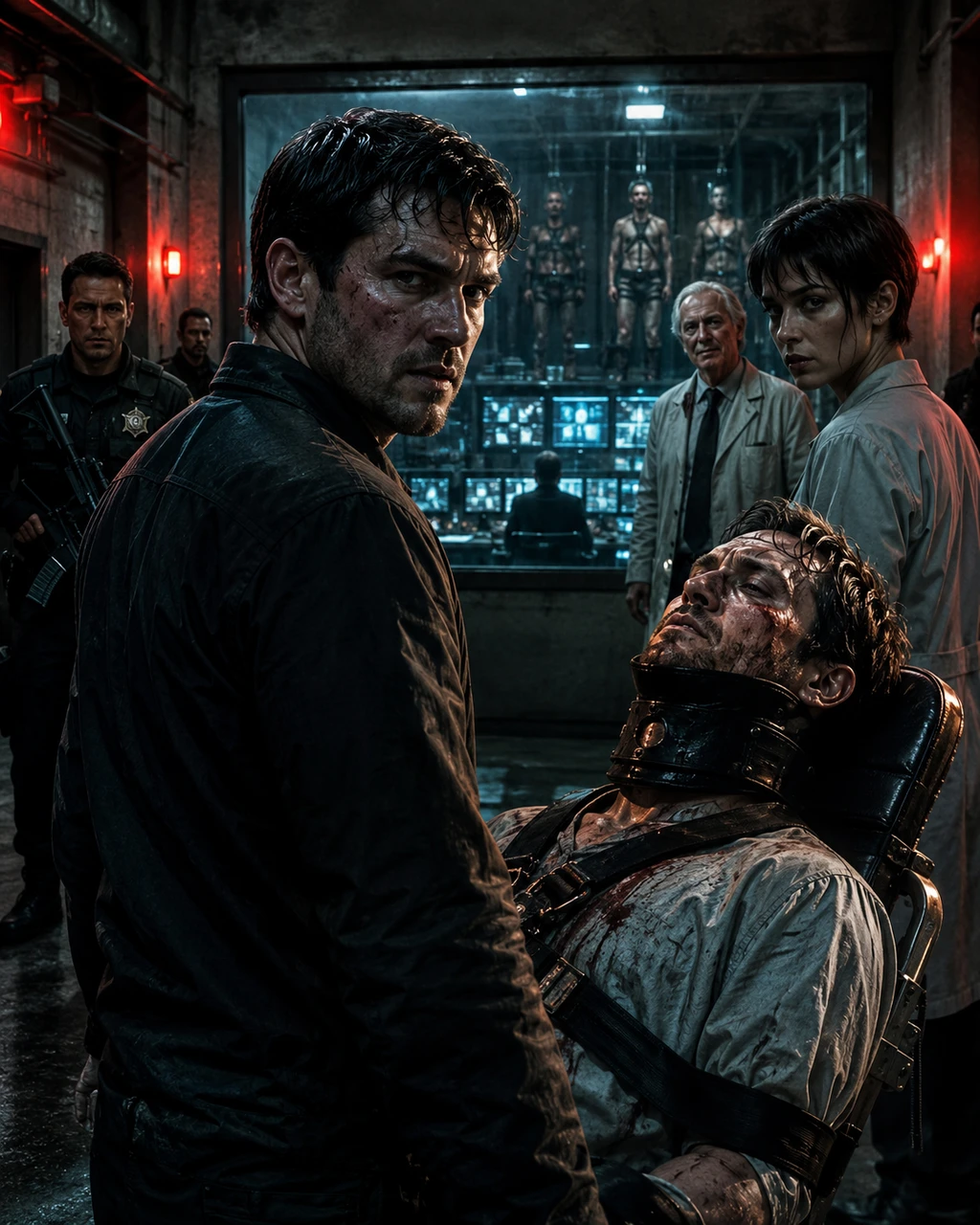
Two men in white protective suits escorted me to Medical Evaluation. They strapped me to a bed, injected something into my arm, and put a metal cap over my head.
Dr. Elaine Chen stood over me with a tablet.
“Memory Reconstruction Protocol,” she said. “You will remember a simple version.”
“I won’t.”
She gave me a sad look.
“One hundred and twenty-seven employees said that.”
The machine turned on.
Pain split my head open.
They tried to erase the tower. Tom. Mia. Jason’s shoe prints. The blue eyes at the gate. The alien in the tank.
They tried to replace it with a new life.
My name was David Miller. I was a systems contractor. I had spent three months updating surveillance software. The preserve was an ordinary research site. There were no creatures. No lab. No murders.
But I had written too much.
Every night, I had logged times, smells, scratches, lights, patterns, names. Memory had roots. They cut at the leaves and hit stone.
When the procedure failed, alarms screamed.
A monitor exploded.
The lights turned blue.
Not emergency blue.
Rule four blue.
Somewhere deep in the facility, the source being woke.
The entire forest answered.
Containment alarms rolled through the underground complex. Doors opened. Not all of them, but enough. A scream came from the hallway, then gunfire, then the heavy wet impact of something large hitting a wall.
Tom burst into the room with blood on his sleeve and Mia behind him.
“Can you walk?” he shouted.
“I think so.”
“Think faster.”
Mia cut my restraints.
“What happened?”
She looked terrified and alive.
“You happened. Whatever they did to your head, it triggered the source.”
Tom shoved the black drive into my hand.
“Ridge tower. Satellite uplink. We go now.”
We ran through a facility collapsing into its own secrets.
Behind glass, creatures slammed against enclosures. Scientists screamed into radios. Sprinklers burst overhead. Blue lights pulsed from ceiling strips, bathing everything in a glow that made the walls look underwater.
At the central corridor, Noll appeared with two armed guards.
“Stop him,” he ordered.
Before the guards could raise their weapons, the wall behind them bent inward.
Something huge struck from the other side.
Again.
Again.
The metal gave.
Subject I-203 stepped through the break.
The wolf-thing from the gate.
It looked at Noll.
Then it looked at me.
Its eyes were blue, but not empty.
Tom whispered, “Don’t move.”
The creature lowered its head.
In my mind, the same pressure returned.
OPEN SKY.
Noll backed away.
“You need me,” he said to the creature, absurdly calm. “I made you.”
The creature’s lips curled.
It spoke in three voices at once.
“No. You named the cage.”
Then the lights went out.
Tom dragged me through the emergency stairwell before I saw what happened to Noll. I only heard his scream cut off behind three closing blast doors.
We made it outside after midnight.
Rain hammered the clearing. The tower lights flickered. In the distance, the hidden gate stood open, pouring blue light into the forest. Shapes moved among the trees — large, small, crawling, flying, watching.
Mia led us north.
The ridge was half a mile beyond the safe zone.
Half a mile through the hunting ground.
We heard Jason’s voice three times.
The first time, he begged.
The second, he laughed.
The third, he said, “I told them you’d come.”
Tom nearly turned.
Mia slapped him hard.
“Not him,” she whispered.
We kept moving.
Something followed us overhead, branch to branch, silent except for the occasional drip of rainwater displaced by weight. Once, a claw touched the back of my jacket and withdrew, as if testing whether I would run.
At the ridge, the old satellite tower stood surrounded by wind-bent pines. Mia opened the service panel. Tom took position with the rifle. I connected the drive.
The upload began.
SECURITY FOOTAGE.
LAB LOGS.
PROJECT GENESIS FILES.
MEMORY RECONSTRUCTION PROTOCOL.
RANGER PROGRAM.
NONCOMPLIANT STAFF TERMINATION.
SOURCE SUBJECT CONTAINMENT.
The progress bar moved like it hated us.
23 percent.
Something roared below.
44 percent.
The trees shook.
61 percent.
Blue light pulsed from the forest floor as if the earth itself were opening an eye.
78 percent.
Tom fired once.
Not at a creature.
At a drone.
It fell burning through the branches.
“They know,” Mia said.
At 92 percent, Dr. Chen’s voice came through the tower speaker.
“Caleb, listen to me. If those files leave this preserve, people will panic. Military containment will fail. Towns will die.”
I looked at the dark forest.
“Towns are already being used as excuses.”
100 percent.
UPLOAD COMPLETE.
We sent it to the FBI, three newsrooms, my mother, a state senator, two environmental watchdog groups, and every public printer in Biotech’s Seattle office.
Then the forest went silent.
Not safe.
Listening.
By sunrise, federal helicopters were over Olympic Forest.
By noon, Biotech Solutions denied everything.
By evening, the first footage aired.
Security cameras showed creatures moving under blue containment lights. Lab logs showed seventy years of experimentation. Bodycam footage from a private security team showed Jason Pike being forced through an outer gate while someone off camera said, “Field response testing begins.”
My notebook became evidence.
Mia testified first.
Tom testified after three days of silence.
I testified in federal court six months later with headaches that still came whenever fluorescent lights flickered too long. Biotech’s attorneys called me unstable. They said memory reconstruction had never happened. They said the footage was fabricated. They said the creatures were misidentified wildlife, then classified defense assets, then not company property, depending on which lie seemed most useful that day.
Then Dr. Elaine Chen turned state’s witness.
She brought the medical records.
One hundred and twenty-seven reconstructed employees.
Forty-three disappearances.
Twelve escaped subjects.
One living source being held without consent since the 1950s.
That was the moment the case stopped being a conspiracy story and became a national crime.
Olympic Forest Preserve was sealed under federal order. Biotech’s board was indicted. Marcus Noll was listed as missing, presumed dead. No body was recovered.
They searched for the source being for weeks after the containment collapse.
The tank was empty.
The cables had been pulled out from the inside.
No one knows whether it escaped, died, or was taken by the creatures that survived the forest.
One year later, I returned to the edge of the preserve with my mother.
Not inside. Never inside.
The gate was gone, replaced by a federal barrier and warning signs. Beyond it, the trees stood wet and enormous under the Pacific Northwest rain. No blue lights. No machinery. No roars.
Mia now worked with investigators tracking corporate black sites.
Tom lived in Idaho, raised goats, and called me every month without saying much.
Jason’s family finally got the truth, though not his body.
My mother held my hand at the fence like I was a child again.
“Was it worth it?” she asked.
I looked into the trees.
For a moment, I saw movement.
A tall shape among the cedars.
Blue eyes.
Watching.
Then it lowered its head once and disappeared into the fog.
“No,” I said. “But it mattered.”
That night, the final file from Project Genesis leaked online.
Not from me.
Not from Mia.
Not from the FBI.
It was a security clip from the deepest lab, timestamped three minutes after the upload.
The source being stood free beside its empty tank. Around it, creatures gathered in the blue light — wolf-shapes, winged things, crawling shadows, all silent.
Then the being looked directly into the camera.
No sound.
No threat.
Just one image that froze the country.
A prisoner looking at the machine that had watched it suffer for seventy years.
Then the camera feed cut to black.
The monsters in Olympic Forest were never supposed to escape.
That was true.
But after everything I saw, after every log, every scratch on the glass, every buried file, every human life used as bait, I understood the part Biotech never wrote down.
Some cages deserve to fail.
And some forests are not haunted by what escaped.
They are haunted by what people built there and called progress.