THE NIGHT NURSE BROKE RULE NUMBER FOUR — THEN SECURITY FOOTAGE, ROOM 413, AND THE RED-GOWNED PATIENTS EXPOSED DR. GRIM’S BASEMENT EXPERIMENTS, PROVING THE DEAD WERE STILL WALKING THE HOSPITAL AND THE NEXT NURSE WAS ALREADY CHOSEN
There was too much blood on my hands at 4:00 a.m., and the worst part was that none of it was mine.
I was locked inside the fourth-floor staff bathroom at St. Jude’s Regional Hospital, crouched between a leaking sink and a trash can, trying not to breathe while something dragged its feet outside the door.
Tap.
Scrape.
Tap.
Scrape.
Then silence.
That was how they moved when they wanted you to listen.
My phone was slick in my palm. Blood kept dripping across the screen, turning my reflection into a red blur. Down the hall, something laughed in a woman’s voice that used to belong to Delaney Brooks, the new night nurse I had been assigned to train.
She had been alive less than twenty minutes ago.
Now she was one of them.
“Jeffrey,” a voice called from outside the bathroom. “We know you’re in there.”
The voice was soft, wet, and wrong.
I pressed my back harder against the tile wall. My name is Jeffrey Cole. I am thirty-one years old. I have been a night nurse at St. Jude’s for three years. I am recording this because if anyone finds my phone, they need to know this hospital is not haunted.
It is worse than haunted.
It is managed.
The door shuddered.
A gray hand slid under the gap, fingers long and thin, nails clicking against the tile. I lifted the phone closer to my mouth.
“Do not work the night shift at St. Jude’s,” I whispered. “And if you do, never break rule number four.”
The hand stopped moving.
A black eye appeared in the crack near the door hinge.
Three years earlier, I had laughed when Head Nurse Evelyn Voss handed me the list.
It was my first night shift. St. Jude’s looked ordinary from the outside, an aging private hospital on the edge of a mid-sized Pennsylvania city, all brick walls, dim parking lots, and donor plaques from families who wanted their names near suffering but never too close to it. The job paid too well. That should have warned me.
Evelyn Voss met me in the nurse supervisor’s office at 10:45 p.m.
She was in her late fifties, silver hair pulled into a severe bun, skin pale from too many years under fluorescent lights. Her left hand trembled when she opened the desk drawer.
“I need you to memorize this,” she said.
She handed me a folded sheet of yellow paper.
The handwriting was old, hurried, and uneven.
SEVEN NIGHT RULES.
-
Never enter Room 413 alone after 2:00 a.m.
If you hear crying from the basement, cover your ears and walk the other way.
Do not look into the fourth-floor bathroom mirror between 3:00 and 3:33 a.m.
If you see patients in red gowns, do not make eye contact. Call the night physician immediately.
If the elevator stops on the fifth floor without being called, do not get out.
If the second-floor hallway lights blink seven times, stand against the wall and lower your face.
If the desk phone rings at 4:44 a.m., do not answer.
I looked up from the paper.
“Is this a joke?”
Evelyn did not smile.
“Twelve night employees have disappeared from this hospital since I started here,” she said. “All of them broke at least one rule.”
I remember laughing once, because the alternative was letting fear enter the room.
“Disappeared?”
“No bodies. No resignations. No real investigation. Just blood, missing security footage, and new job postings by Monday.”
She rolled up her left sleeve.
Four deep scars ran from wrist to elbow, pale and raised like old rope under her skin.
“I broke rule three fifteen years ago,” she said. “I looked into the mirror at 3:15.”
“What did you see?”
Her eyes went colder.
“Something that saw me back.”
Then she leaned forward, lowering her voice.
“Most of all, Jeffrey, never trust Dr. Arthur Grim.”
I had seen his name on plaques near the lobby. Founder. Chief Research Director. Major donor. The kind of doctor rich families trusted because his portrait hung near marble.
“Why?”
Evelyn folded the rule sheet into my hand.
“Because whatever he was when this hospital opened, he is not that anymore.”
For three years, I followed every rule.
I walked away from basement crying. I lowered my eyes when the second-floor lights blinked. I stayed inside elevators when they opened onto the fifth floor and showed me hallways that should not exist. I ignored the fourth-floor mirror between 3:00 and 3:33, even when someone inside it whispered my name.
Then Delaney Brooks arrived.
She was twenty-six, bright-eyed, fresh from a county hospital, and far too kind for night work. She smiled at patients. She called everyone “hon.” She brought her own coffee in a pink travel mug and asked too many questions.
Dr. Grim hired her personally.
That was the first sign.
On her first night, I found her at the nurse station reading through charts, blonde hair tied back, eyes narrowed in concentration.
“You’re Jeffrey?” she asked.
“Jeff.”
“I heard you’re training me.”
“You heard wrong. Nobody trains anyone here. They just warn them.”
She laughed.
I did not.
I gave her a copy of the rules.
She read them and looked up slowly. “This is serious?”
“Dead serious.”
Before she could answer, the lights on the second floor blinked seven times on the security monitor above the desk.
Once.
Twice.
All the way to seven.
I grabbed Delaney by the wrist and pulled her against the wall.
“Face down,” I whispered.
“What?”
“Now.”
A tall shadow passed the camera feed.
Not a person. Too narrow. Too long. Wearing what looked like a hospital gown, but the video color was wrong, oversaturated, dark red bleeding into the frame.
Delaney stopped breathing.
The shadow turned its head toward the camera.
The screen went black.
When the feed came back, the hallway was empty.
Delaney’s voice was barely there. “What was that?”
“Rule six.”
She looked at the paper in her hand again.
This time she did not laugh.
At 1:50 a.m., Room 413 called the nurse station.
The room had no assigned patient. It never did. St. Jude’s was often over capacity, but Room 413 had been listed as “under maintenance” for eleven years.
The call light blinked anyway.
Delaney reached for the phone.
I caught her hand.
“No.”
“There could be someone in there.”
“There isn’t.”
“Then why is the light on?”
“That’s how this place asks questions.”
She pulled her hand away. “Jeff, I’m a nurse.”
“So am I.”
“Then act like one.”
That hurt more than it should have.
At 2:07 a.m., she walked toward Room 413.
I followed because letting her go alone would have been another kind of murder.
The hallway felt longer than usual. Hospitals at night have a particular silence, not empty, just restrained. Machines hum behind walls. Air vents breathe. Distant monitors beep like coded warnings. But the fourth floor had gone quiet in a way that felt intentional.
Room 413’s door was slightly open.
Delaney pushed it wider.
The room looked normal. White sheets. Empty bed. Visitor chair. A dark window reflecting our faces.
Then the door slammed behind us.
Delaney flinched.
The bed began to shake.
The sheets rippled as if something underneath them were crawling. A dark stain spread across the mattress from the center outward, too fast to be spilled liquid, too deliberate to be a leak.
“Jeff,” Delaney whispered.
A hand rose from the mattress.
Not through the blanket.
Through it.
Long fingers pushed up from inside the bed as if the cotton and foam had turned to water. Then came an arm, a shoulder, wet black hair, and a face too pale to belong to anyone alive.
“Modica warned you,” it said.
I knew that name.
Michael “Maddox” Kane, the night nurse before me.
He had vanished four years earlier.
The thing crawled halfway out of the bed, its hospital gown soaked, its eyes black from lid to lid.
“Grim is waiting,” it said. “He already chose the next one.”
The door opened behind us.
I grabbed Delaney and ran.
We did not speak until we reached the stairwell. She was crying silently, one hand clamped over her mouth.
“What is this place?” she whispered.
“A place that keeps hiring night nurses.”
The next clue came from security footage.
Delaney had access to the administrative camera system because Dr. Grim had given her temporary credentials. She said it like it was normal. It was not. New nurses did not get access to archived security.
At 2:40, while the hospital slept around us, we pulled footage from the night Maddox disappeared.
The official file was blank for forty-three minutes.
Delaney clicked into a backup cache the system was not supposed to show.
The footage stuttered.
There was Maddox walking past Room 413.
He stopped.
Turned.
Looked directly at someone off camera.
Then two patients in red gowns entered the frame.
Their heads were bowed. Their feet were bare. Their movements were slow but synchronized, as if they were being pulled by the same string.
Maddox backed away.
A hand appeared on his shoulder.
Dr. Arthur Grim stepped into view.
Tall. Silver-haired. White lab coat. Calm face.
No panic.
No surprise.
He guided Maddox toward the service elevator like a man escorting a guest to dinner.
The elevator doors opened.
The basement button lit by itself.
Then the footage cut out.
Delaney turned to me, face white.
“He told me Maddox transferred to another facility.”
“Grim tells people whatever keeps them walking.”
A sound came from the stairwell camera.
At first I thought it was static.
Then I realized it was crying.
Rule two.
Delaney’s eyes filled with dread.
From somewhere below us, a woman sobbed.
“Please,” she cried. “Please let me die.”
Then Dr. Grim’s voice answered, gentle as a father.
“You already did, Mariah. Three times. This time we improve the outcome.”
Delaney covered her mouth.
I stood there frozen, feeling something inside me rearrange itself from fear into evidence.
“We need to call the police,” she said.
“They’ve been called before.”
“Then the FBI.”
“We need proof they can’t bury.”
She looked at the screen.
“Then we get it.”
That was the moment Delaney stopped being the new nurse.
She became the witness.
At 3:05 a.m., the fourth-floor bathroom door opened by itself.
I heard it from the nurse station. A soft click. A hinge groan.
Delaney looked at the clock.
“Rule three.”
“Don’t go near it.”
“I’m not.”
But the monitor above us flickered, and the bathroom camera came alive.
There should not have been a camera inside the bathroom. It was illegal. St. Jude’s had one anyway, hidden above the supply vent.
The mirror filled the frame.
For three seconds, it reflected an empty room.
Then it reflected Dr. Grim’s basement.
Rows of surgical tables.
Red gowns hanging from hooks.
Bodies strapped down under white lights.
A nurse in restraints.
Maddox.
Alive enough to blink.
Delaney made a sound that was almost a scream.
On the screen, Grim leaned close to Maddox and whispered something. Maddox’s mouth opened. No sound came through the feed.
Then Grim looked up at the mirror.
At us.
The screen went dead.
Behind us, the desk phone rang.
Once.
Twice.
The clock read 4:44 a.m.
Delaney reached for it.
I slapped her hand away.
“No.”
Her eyes were wet and furious. “He knows we saw.”
“Yes.”
“Then he already knows we’re coming.”
I stared at the dead monitor.
“No,” I said. “He thinks we’re afraid.”
We went to the basement anyway.
Not because we were brave. Because security footage without the source could be dismissed. Because St. Jude’s had donors, lawyers, county officials, board members, and a research wing sealed behind words like “proprietary” and “experimental.” Because twelve people had vanished, and every missing person report had been softened into “resignation,” “relocation,” or “mental health crisis.”
The basement door stood behind the old laundry corridor.
A sign read:
AUTHORIZED RESEARCH STAFF ONLY.
Below it was a newer sign:
DR. ARTHUR GRIM, DIRECTOR.
Delaney filmed everything on her phone.
I used my badge to try the reader.
Denied.
Then the door opened from inside.
Dr. Grim stood in the white light.
He looked exactly like his portraits, only older in a way portraits never admit. Tall, thin, silver hair, gray eyes behind round glasses. His lab coat was spotless, except for one red fingerprint near the cuff.
“Jeffrey,” he said. “Delaney. I wondered when curiosity would overcome policy.”
Delaney lifted her phone.
“You’re being recorded.”
Grim smiled.
“My dear, so is every room in this hospital.”
Behind him, something moved.
A woman in a red patient gown stepped into the light. Her skin had a bluish cast. Her eyes were black. Her expression was almost human until she smiled.
Too wide.
Delaney looked straight at her.
Rule four.
“Delaney,” I snapped.
But it was done.
The red-gowned woman tilted her head.
“New one,” she whispered.
Grim’s smile deepened.
“That is unfortunate,” he said. “But not unexpected.”
Delaney staggered as if something invisible had hooked into her chest.
I grabbed her and ran.
The basement alarms began screaming.
We made it to the stairwell before the doors locked.
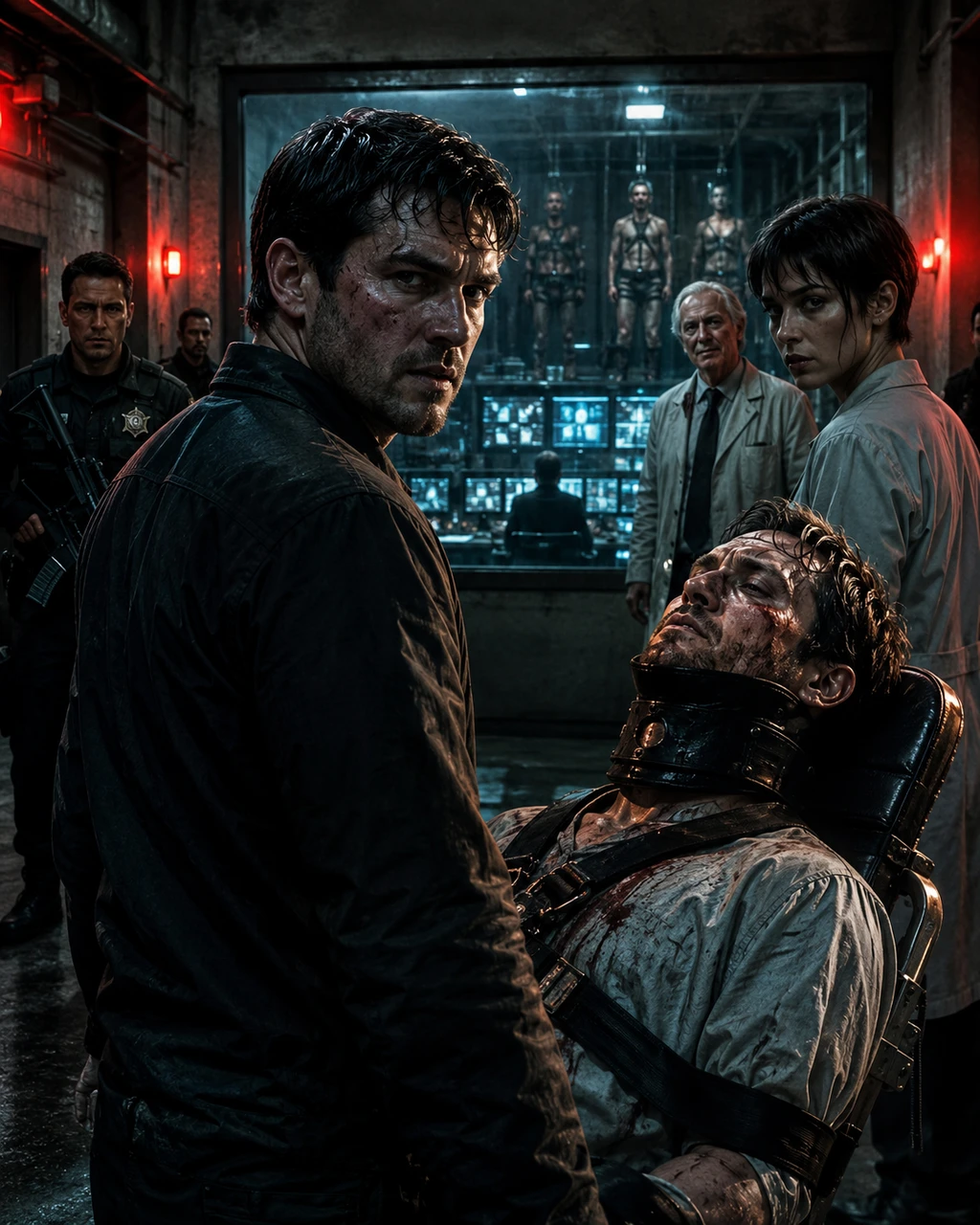
Red-gowned patients appeared on the landings above and below us. Bare feet. Wet hands. Black eyes. Hospital bracelets with numbers instead of names.
Subject 27.
Subject 31.
Subject 42.
Subject 39.
Maddox.
He stood on the lower landing, red gown hanging loose from his shoulders. Part of his face twitched as if he were trying to remember being a man.
“Jeff,” he rasped.
I froze.
He lifted one hand and pointed upward.
“Cameras,” he said. “Room 413 keeps the old feed.”
Then he lunged at the patient nearest him, buying us three seconds.
We ran.
Room 413’s door was open when we reached it.
Inside, the bed was gone.
The walls had split open behind removable panels, revealing racks of hard drives, old VHS decks, backup servers, and a monitoring station wired directly into the basement. The room was not empty.
It was the archive.
Delaney locked the door while I tore through the equipment.
“Find anything labeled night wing, basement, research, subject logs,” I said.
“You know how to use this?”
“No. But I know how hospitals hide things. They label evil as inventory.”
She found the red binder first.
BASEMENT TRIALS — CONTINUITY PROJECT.
Inside were names.
Cassandra Leigh. Security guard.
Michael Kane. Night nurse.
Elina Harper. Trauma patient.
Mariah Voss. Unclaimed body.
Forty-seven subjects.
Some marked failed.
Some marked stable.
Some marked ambulatory.
Next to Subject 48 was a blank line.
Then my name.
JEFFREY COLE — VIABLE.
Under Subject 49 was Delaney Brooks.
NEWLY SELECTED.
Delaney stared at the page.
“He chose me before I started.”
“No,” I said. “He hired you because he chose you.”
Her phone trembled in her hand.
“We need to get this out.”
The door handle turned.
Once.
Then again.
Grim’s voice came through the door.
“Jeffrey, you’re a nurse. You understand triage. Some lives must be used to save others.”
Delaney looked at me.
I pulled a hard drive from the rack.
“Do you have cloud backup?”
“Yes.”
“Upload everything.”
“They’ll cut the network.”
“Then send it to everyone before they do.”
She connected her phone. Files began transferring.
Outside, something scratched the door.
Grim sighed.
“You think exposure frightens me? The board knows. The county knows enough. Families with money know what grief is worth. I offer what they want most.”
The upload bar crawled.
24 percent.
I opened the red binder again and found the donor list.
There it was.
Hospital board members.
Private foundations.
A county commissioner.
Two judges.
A former sheriff.
Families paying for “continuity trials” on dead relatives while night nurses and unclaimed patients became disposable bodies.
This was not madness.
It was a business model.
54 percent.
The lights went out.
Emergency red filled the room.
On the monitor wall, security footage flickered to life by itself. The basement. The hallways. The stairwell. The red-gowned patients gathering outside Room 413.
Then one screen showed the fourth-floor bathroom.
The present.
An empty stall.
A pool of blood.
The future, maybe.
Delaney whispered, “Jeff.”
87 percent.
The door cracked.
A gray hand pushed through.
Delaney grabbed a metal IV pole and swung. The hand snapped back.
100 percent.
UPLOAD COMPLETE.
She hit send.
The files went to local news, the state nursing board, three federal tip lines, my sister, her father, and every printer in the hospital administration office.
Then the door burst inward.
What happened after that came back to me in fragments.
Red gowns.
A fire alarm.
Delaney screaming my name.
Maddox blocking the hallway, holding two patients back with strength his dead body should not have had.
Evelyn Voss appearing at the stairwell with a security axe and the face of a woman who had spent fifteen years waiting to stop being afraid.
“Run!” she shouted.
“We have the files!” Delaney yelled.
“Then burn the source.”
Evelyn knew where the oxygen lines fed the basement lab. She knew because she had mapped the hospital for years, waiting for one night when evidence and witnesses existed at the same time.
Grim caught us outside the basement.
He was no longer smiling.
“You cannot kill progress,” he said.
Evelyn lifted the axe.
“No,” she said. “But we can document it.”
Behind him, the red-gowned patients stopped moving.
The monitors in the hall began playing the uploaded footage on loop.
Grim’s surgeries.
The body transfers.
The injections.
Maddox dragged into the elevator.
Delaney being listed as Subject 49.
The hospital saw itself.
For one second, even the dead seemed to understand.
Maddox turned on Grim first.
Then the others followed.
I pulled Delaney away before the fire doors slammed.
The explosion did not look like a movie. It was not clean or beautiful. It was a dull, concussive roar from somewhere deep under the hospital, followed by black smoke pouring through vents and sprinklers hammering water into every corridor.
By sunrise, St. Jude’s was surrounded.
Fire trucks. Police cruisers. FBI vans. Local news helicopters. Patients wrapped in blankets on the lawn. Nurses crying in the parking lot. Board members shouting into phones that no one wanted to answer anymore.
Dr. Grim’s basement survived the fire.
So did the servers in Room 413.
That was the part that saved us.
By noon, the FBI had the footage.
By evening, every major station had it.
By midnight, the county commissioner resigned. The hospital board was under federal investigation. The research wing was sealed. Families of missing employees stood outside the gates holding photographs, no longer begging for answers from the same people who buried them.
Delaney lived.
Barely.
She had looked into the eyes of a red-gowned patient, and something had entered her bloodstream through fear, through whatever Grim had made them carry. Her blood darkened for three days. Her temperature dropped. Her veins turned faintly gray at the wrists.
Evelyn found the reversal in Grim’s handwritten logs.
It required returning to the basement before the seventy-second hour.
Delaney did not hesitate.
Neither did I.
We went back with federal agents, body cameras, emergency lights, and Evelyn’s rules written on the backs of our gloves.
The basement smelled of smoke, antiseptic, and wet concrete.
In the central lab, beneath a cracked observation window, we found the original formula locked in a steel drawer labeled 413-R.
Not Room 413.
Research 413.
Grim had named the hospital room after his first successful containment chamber.
The reversal nearly killed Delaney.
She seized on the lab floor while Evelyn injected the counteragent into her arm and I held her shoulders down, begging her to stay angry, stay breathing, stay human.
For one terrifying second, Delaney opened her eyes and they were black.
Then she whispered, “Rule four.”
I leaned close.
“What?”
She swallowed.
“Don’t look away from the people they tried to erase.”
Her eyes cleared.
Three months later, St. Jude’s was no longer a hospital.
It was a crime scene.
The civil hearings were held in federal court because too many local officials were involved. Families filled the benches. Former night workers testified. Security footage played on large screens while lawyers tried and failed to make it sound less horrific.
Evelyn Voss testified for six hours.
Delaney testified for two.
I testified last.
They asked me if Dr. Grim believed he was saving lives.
I said yes.
Then I said that was the most dangerous thing about him.
A monster who knows he is a monster can be stopped by fear, shame, or force. But a man who calls cruelty progress can build a basement under a hospital and convince wealthy people to fund it.
The court ordered the release of all missing employee records.
Maddox Kane was finally declared dead.
So were Cassandra Leigh, Robert Ellis, Nina Harper, and nine others whose families had been told they walked away.
Their names were read aloud outside the hospital gates the day the sign came down.
Delaney stood beside me, her hand wrapped around mine, a faint scar still visible at her wrist.
“What happens to the red-gowned patients?” she asked.
I looked toward the sealed entrance.
The official answer was that no ambulatory subjects survived the containment collapse.
The unofficial answer was on one final piece of security footage the FBI never released publicly.
At 4:44 a.m., three nights after the raid, the camera outside the east fire exit blinked on.
A red-gowned woman stood in the rain.
Elina Harper.
Subject 42.
She looked directly into the camera, but not like a threat.
Like a witness.
Then she placed a hospital badge on the ground and walked into the dark.
The badge belonged to Dr. Arthur Grim.
They never found his body.
But they did find his journals, his donors, his formulas, his patient numbers, and his next hiring list.
At the top was Delaney’s name.
Below hers was another.
A nurse scheduled to start the following Monday.
The next nurse had already been chosen.
Only this time, when she arrived at St. Jude’s, there was no hospital left to swallow her.
There was only a fence, a federal seal, a wall of flowers, and a handwritten copy of seven rules taped to the gate.
Someone had added an eighth.
IF THEY TELL YOU IT’S FOR THE GREATER GOOD, ASK WHO THEY PLAN TO BURY FIRST.
I still work nights.
Not at St. Jude’s. That place is gone now, its windows dark, its basement filled with concrete, its name stripped from every official record that once protected it.
But some nights, when the hallway lights blink too evenly, or a phone rings at 4:44 with no caller ID, I remember the bathroom tile under my knees and Delaney’s blood on my hands.
I remember the red gowns.
I remember Room 413.
And I remember that the dead were walking the hospital not because death had failed, but because the living had signed the forms.
That is the part nobody wants to admit.
The dead did not build the basement.
People did.